Invoice factoring is a way to get paid sooner by selling your unpaid invoices to a finance company, called a factor, which pays you most of their value upfront and then collects the money from your customers. Invoice discounting is similar, but you borrow against the invoices, keep collecting payments yourself and usually keep the arrangement confidential.
Both are forms of invoice financing, generally open only to businesses that sell to other businesses on credit.
General information, not financial advice. This article describes how these products generally work as of October 2026 and recommends no provider. Terms, costs and rules vary by provider and country, so read any agreement in full and ask an accountant or independent financial advisor before you commit.
Key takeaways
- UK government guidance (September 2026) cites advances of up to 80% to 90%, paid for with a service fee plus a discount charge that works like interest.
- With recourse, a bad debt comes back to you. Non-recourse shifts some of that risk to the factor, at a price.
- Convert every quote into an annual rate and compare it with deposits, shorter terms and a line of credit.
What is invoice financing?
Invoice financing means raising cash from invoices your customers haven't paid yet. According to the British Business Bank, the UK's government-owned development bank, providers look mainly at the strength of your business and the invoices owed to you, with less focus on your short-term financial performance.
Terms differ by country. UK guides say "invoice finance" for both products and "debtors" for the money owed to you. US guides say accounts receivable, and call borrowing against it invoice financing or accounts receivable financing (SBA blog, 2019).
How invoice factoring works
A typical arrangement, as described by nibusinessinfo.co.uk, Invest Northern Ireland's official business advice site:
- You send the invoice as usual, with instructions to pay the factor.
- The factor advances an agreed percentage, usually within 24 hours once the facility is set up (British Business Bank).
- The factor chases payment, following a contact protocol you agree in advance.
- Your customer pays the factor in full, and you receive the balance, minus fees.
In the US, once your customer receives a valid notice of assignment, paying you instead of the factor doesn't settle its debt (UCC § 9-406).
Typical advance rates
The British Business Bank's guide (updated September 2026) says providers advance up to 80% or 90% of invoice value. In the US, the OCC's asset-based lending handbook for bank examiners (January 2017 edition) puts common advance rates on bank loans against receivables at 70% to 85% of eligible receivables, and up to 90% at some banks. Expect less, or nothing, against invoices that are disputed or badly overdue. Funding may also be limited if one customer makes up more than about a third of your turnover (Invest Northern Ireland, undated).
Recourse vs non-recourse factoring
Recourse factoring leaves the bad-debt risk with you. If your customer hasn't paid within a set period after the due date, you refund the advance and still owe the fees. In an example from Invest Northern Ireland's recourse guide, a £10,000 invoice gets an £8,000 advance; if it's unpaid at the agreement's three-month limit, you repay the £8,000.
Non-recourse factoring moves specified risks of your customer failing to pay to the factor, for an extra credit protection charge. It doesn't cover genuine disputes, and the factor takes over the right to pursue your customer, including in court. Check whether a covered bad debt means only insolvency or slow payment too.
Invoice factoring costs and fees
Pricing usually has two parts, says the British Business Bank: a service fee, a percentage of each invoice's value that's higher for factoring because collection is included, and a discount charge, which works like interest on the money you've drawn. Invest Northern Ireland's undated cost guide gives these typical UK ranges (checked October 2026):
| Charge | Typical UK range |
|---|---|
| Discount charge | 1.5 to 3 points above base rate |
| Service fee, factoring | 0.75% to 2.5% of turnover |
| Service fee, invoice discounting | 0.2% to 0.5% of turnover |
| Credit protection (non-recourse) | 0.5% to 2% of turnover |
If "base rate" means the Bank of England's Bank Rate (3.75% in October 2026), that discount charge works out at roughly 5.25% to 6.75% a year. Ask what else is charged: set-up, credit checks, transfers, audits, monthly minimums or leaving early.
In the US, factoring is commonly priced as a percentage of the invoice's face value rather than as an annual rate (SBA blog, 2017). We found no official source for typical US factoring fees, but New York's disclosure rules require many non-bank providers of business financing up to $2.5 million, factoring included, to show New York-based businesses an estimated annual percentage rate (APR). Ask for one wherever you are.
How invoice discounting works
Invoice discounting is a revolving facility secured on your invoices. You report your sales ledger to the provider, usually electronically, and draw up to an agreed percentage of it, again up to about 90% (British Business Bank). You keep collecting; as customers pay, the money goes to the provider and frees up funding for new invoices (nibusinessinfo.co.uk).
Many facilities are undisclosed, so customers needn't know. The trade-off is eligibility. Providers want a track record and solid credit control, and an undated Invest Northern Ireland page says discounting is normally for businesses turning over around £500,000 a year, though the British Business Bank notes more providers now offer it to smaller firms.
Factoring vs invoice discounting: pros and cons
| Invoice factoring | Invoice discounting | |
|---|---|---|
| The invoice | Sold to the factor | Used as security for borrowing |
| Who collects | The factor | You |
| Customer awareness | Usually aware: invoices say to pay the factor | Often confidential |
| Cost | Higher service fee plus a discount charge | Lower service fee plus a discount charge |
| Eligibility | Business-to-business sellers; generally easier for smaller firms | Established firms with larger turnover and good credit control |
| Bad-debt risk | Yours (recourse) or the factor's (non-recourse, at extra cost) | Depends on the terms |
| Other pros | Fast cash that grows with sales; customer credit checks done for you | You keep your customer relationships |
| Other cons | The factor's manner reflects on you; disputes cut your funding; leaving means repaying advances on unpaid invoices | Regular reporting; can mean a long contract |
Sources: British Business Bank; Invest Northern Ireland's pros and cons of factoring.
Worked example: the real cost on a $10,000 invoice
Take one $10,000 invoice on 30-day terms that your customer pays on day 45. These rates are illustrative, not market quotes: an 85% advance, a service fee of 1.5% (factoring) or 0.5% (discounting) of the invoice, and a discount charge of 10% a year on the money advanced, charged daily. That 10% is deliberately above the UK range.
| Illustrative figures | Factoring | Discounting |
|---|---|---|
| Advance (85%) | $8,500.00 | $8,500.00 |
| Service fee | $150.00 | $50.00 |
| Discount charge ($8,500 × 10% × 45 ÷ 365) | $104.79 | $104.79 |
| Total cost | $254.79 | $154.79 |
| You keep in total | $9,745.21 | $9,845.21 |
| Effective annual cost | 24.3% | 14.8% |
Effective annual cost = total cost ÷ money advanced × 365 ÷ days. For factoring: $254.79 ÷ $8,500 = 3.00% for 45 days, and 3.00% × 365 ÷ 45 = 24.3% a year. For discounting: $154.79 ÷ $8,500 = 1.82%, or 14.8% a year. These are simple rates, not compounded: a comparison tool, not a formal APR.
The service fee is charged on the full $10,000, though you get only $8,500 upfront. Time also drives the bill: if a provider instead charged 2% of the invoice per 30 days or part of 30 days, day 45 would count as two periods and cost $400, about 38% a year. With factoring, weigh the cost against the collection work you no longer do yourself (British Business Bank).
Invoice factoring for small business: who each option suits
Factoring suits smaller or fast-growing firms with creditworthy but slow-paying business customers and no time for credit control. The British Business Bank says it's generally easier for smaller businesses to get, usually for annual sales of up to £2 million.
Invoice discounting suits established firms with larger turnover, good bookkeeping and their own credit control, especially if they want privacy.
Selective or spot factoring, which finances chosen customers' invoices or single invoices rather than your whole sales ledger, suits occasional needs. The British Business Bank says a traditional facility generally doesn't suit businesses turning over less than £300,000 a year.
Neither works well if you sell mainly to consumers or have frequent disputes, part payments or stage payments (Invest Northern Ireland). If customers take more than 90 days to pay, some providers may turn you down (British Business Bank). And no financing fixes an unprofitable business.
Alternatives to invoice financing
Australia's business.gov.au notes that factoring can be expensive compared with traditional finance, so try these first:
- Deposits or staged payments. Ask larger clients to pay part upfront with a deposit invoice.
- Shorter terms. Moving new customers from net 60 to net 30, or net 30 to net 15, costs no fees. See net 30 payment terms explained.
- Early-payment discounts, with care. 2/10 net 30 gets you paid 20 days sooner but costs about 37% a year (2 ÷ 98 × 365 ÷ 20), which can exceed the cost of financing.
- A business line of credit or overdraft. Most asset-based loans and lines of credit cost less than factoring, according to the 2017 SBA blog post. In the US, the SBA's 7(a) Working Capital Pilot offers monitored lines of credit of up to $5 million through participating lenders.
- Tighter collections. Invoice the day you deliver, print the due date and follow up on a schedule. This guide to collecting overdue invoices has email templates, and an invoice tracker shows where money is stuck.
Clear invoices get paid with fewer questions, so start from professional invoice templates or our step-by-step invoicing guide. If you do apply, a provider will want your latest accounts and details of your outstanding invoices (British Business Bank).
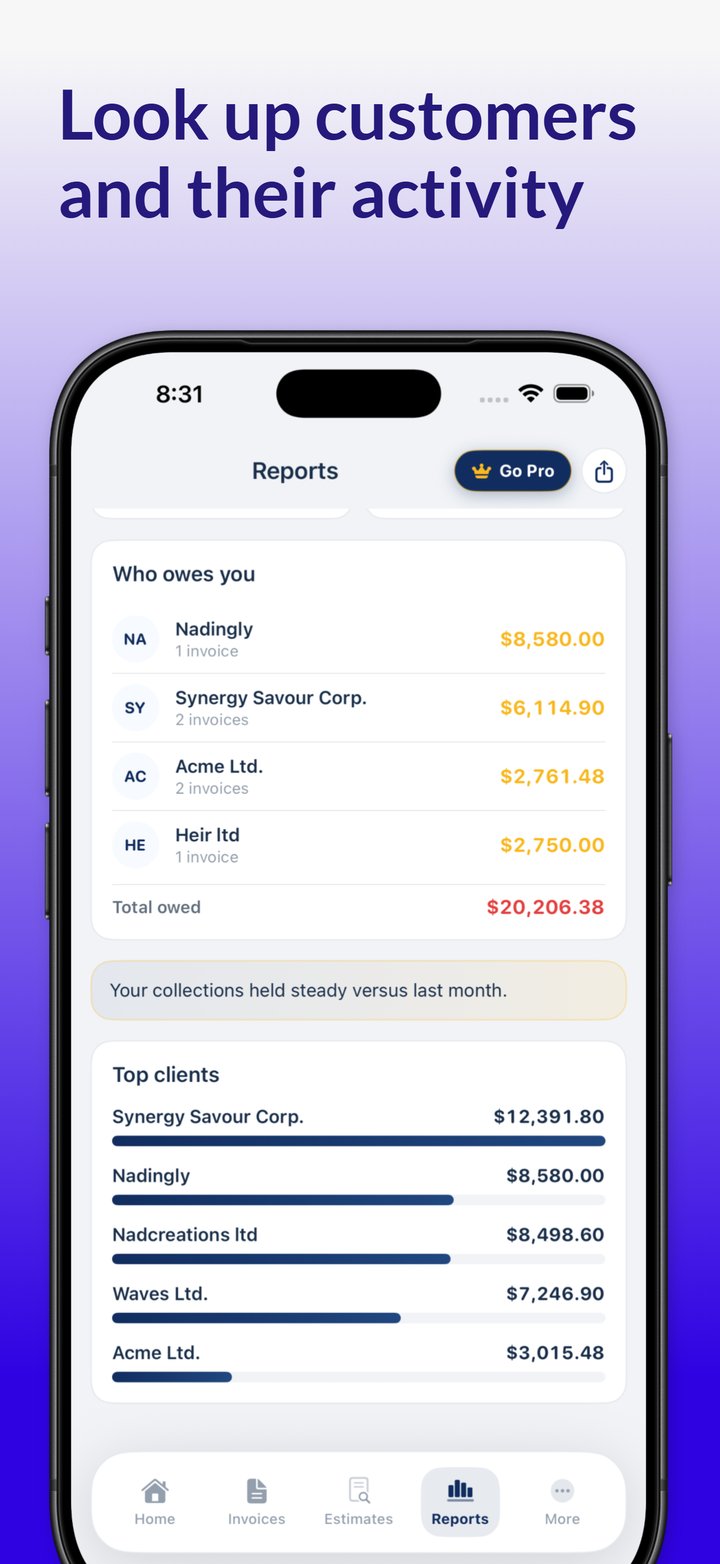
See what's still outstanding. Invoicious, an invoice generator for iPhone and iPad, tracks every invoice as paid, unpaid or overdue.
Get Invoicious freeQuestions to ask any provider, and warning signs
Whether you're comparing invoice factoring services or invoice discounting companies, get the answers in writing, as the Federal Trade Commission's 2021 guidance on small business financing advises:
- Fees: What is every fee, and what's the total, as an annual rate, on a sample invoice paid on time and 30 days late?
- Minimums: Is there a minimum monthly volume or fee? Can I choose which invoices to finance?
- Contract length and termination: What's the minimum term, does it renew automatically, and what notice and exit fees apply? Most UK providers want three months' notice; some want up to a year (Invest Northern Ireland, undated).
- Recourse: With or without? How long after the due date before I must repay, and what counts as a bad debt?
- Advance: What percentage, and which customers or invoices are excluded?
- Your customers: How often will you contact them, and in whose name? How do you handle disputes? Can I speak to current clients?
- Security: Do you need a personal guarantee, and what will you register against my business? In the US, state law based on UCC Article 9 covers sales of receivables (§ 9-109), so expect the provider to file a public financing statement (§ 9-310). Ask whether it covers only receivables or all your assets.
In the UK, ask whether the provider is a UK Finance member bound by its Standards Framework, which includes a code of conduct and an independent complaints process (British Business Bank).
Warning signs. Be wary of a low headline rate with no total cost, or of fees, recourse terms and guarantees the provider won't put in writing. The FTC says to treat unsolicited financing emails with suspicion, and if a salesperson is rushing you, to rush in the opposite direction.
