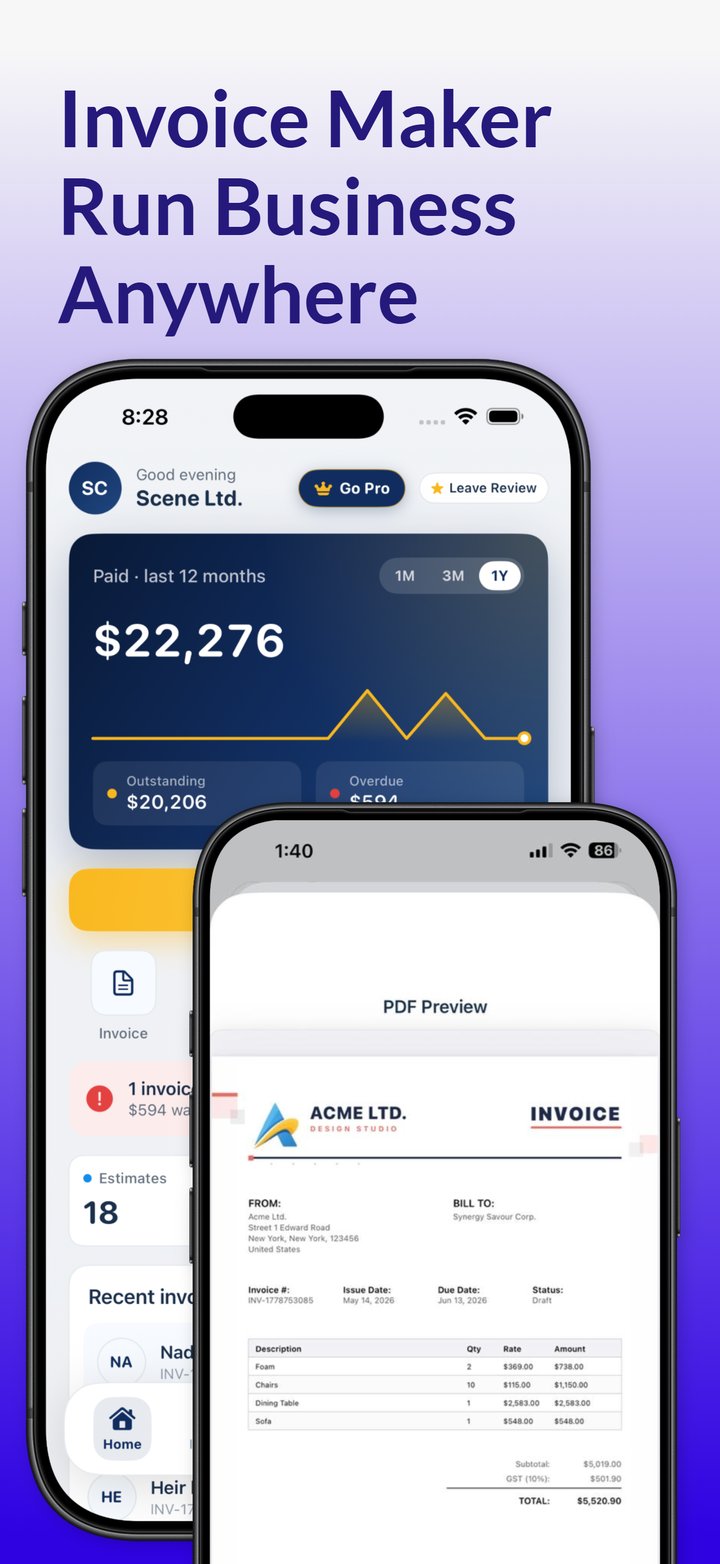
To collect outstanding invoices, follow up on a fixed schedule: a courtesy reminder before the due date, emails 1 and 7 days after it, a phone call on day 14 and a final notice on day 30. If an overdue invoice still isn't paid, offer a payment plan, send a letter before action or go to small claims court.
Key takeaways
- Outstanding means sent but unpaid. Overdue and past due mean the due date has passed.
- Many late payments are admin problems, so start friendly, and keep every reminder and promise in writing as evidence.
- UK businesses paid late by another business can, by default, claim interest at 8% above the Bank of England base rate in force on the relevant reference date, plus £40 to £100 compensation. Elsewhere, check local law.
- Write off a debt when chasing costs more than you'd recover; tax relief depends on your accounting method.
Outstanding vs overdue vs past due: what's the difference?
- Outstanding invoice: any invoice you've sent that hasn't been paid in full, due or not.
- Overdue invoice: an outstanding invoice whose due date has passed.
- Past due invoice: the same as overdue, as in "30 days past due" on a statement.
An invoice dated October 1 on net 30 payment terms is due October 31. On October 20 it's outstanding but not overdue; on November 30 it's 30 days past due.
Each week, sort unpaid invoices by days overdue (1–30, 31–60, 61–90, 90+) and chase the oldest and largest first. An invoice tracker makes that quick.
How to collect outstanding invoices: a follow-up timeline
Use one sequence for every client, counted from the due date, so you never wonder whether it's too soon to chase.
| When | What to do | How |
|---|---|---|
| 3–5 days before the due date | Courtesy reminder: amount, due date, how to pay. | |
| Day 1 overdue | Friendly reminder: ask when it's scheduled for payment. | |
| Day 7 | Second reminder. Ask what's holding it up, and check you're writing to the person who pays. | |
| Day 14 | Call the client or their accounts team. No answer? Send the firm follow-up. | Phone, then email |
| Day 30 | Final notice: a deadline 7–14 days away and the consequence if it's missed. | Email and letter |
| Day 45 | Do what the final notice said: pause work, add any agreed late fee, send a letter before action. | Letter by mail and email |
| Day 60+ | When the letter's deadline passes, choose small claims court, a collections agency or a write-off. | Court, agency or write-off |
Keep reminders in one email thread and reattach the PDF each time.
Know which invoices are overdue. Invoicious tracks each invoice as paid, unpaid or overdue, and you can resend the PDF by email, Messages or another app when you follow up.
Get Invoicious freeOverdue invoice email templates
Each uses a fictional invoice: #1042 for $2,400, due October 31. For the first invoice email and a pre-due reminder, see the guide to invoice email format.
Friendly reminder (day 1 overdue)
Subject: Invoice #1042 for $2,400 was due yesterday
Hi Sam,
A quick reminder that invoice #1042 for $2,400 was due yesterday, October 31. I've attached it again in case it got buried.
Could you let me know when it's scheduled for payment? Bank details are on the invoice.
Thanks,
Priya, Northwind Studio
Firm follow-up (day 14 overdue)
Subject: Invoice #1042 is now 14 days overdue
Hi Sam,
Invoice #1042 for $2,400 is now 14 days overdue. I emailed on November 1 and 7 and left you a voicemail today, but haven't heard back. A copy is attached.
If something needs correcting or it's waiting for approval, tell me this week and I'll help sort it out. Otherwise, please pay by November 21 or reply with a payment date.
Thanks,
Priya
Final notice (day 30 overdue)
Subject: Final notice: invoice #1042 ($2,400) is 30 days overdue
Hi Sam,
Invoice #1042 for $2,400 was due on October 31 and is now 30 days overdue. I sent reminders on November 1, 7 and 14 and left a voicemail, but haven't received payment.
Please pay the full $2,400 by December 7. If I haven't received payment or agreed on a payment plan with you by then, I will pause further work, add the late fee set out in our agreement and file a small claims case for the balance.
If paying in full is a problem, call me at 555-0142 before December 7 and we can agree on a plan.
Regards,
Priya Shah, Northwind Studio
Only name consequences you'll carry out, and delete the late-fee line if your contract doesn't include one.
A phone script for a past due invoice
A call is harder to ignore than an email and often reveals the real reason for the delay. Ask for whoever approves payments.
Call script: invoice #1042, 14 days overdue
Opening: "Hi, this is Priya from Northwind Studio. I'm calling about invoice 1042 for $2,400, due October 31. Could you check where it is?"
If it's being processed: "Thanks. What date will payment go out? I'll email to confirm."
If they never got it: "I'll email it now. Which address should I use, and does it need a PO number?"
If they dispute part of it: "What exactly needs changing? Could you pay the undisputed part now while we sort out the rest?"
If they can't pay in full: "How much could you pay this week? Let's agree on installments for the rest, and I'll confirm them in writing."
Afterward, email a summary: the amount, the date and who is paying. If the promise isn't kept, that email is your evidence.
Late fees and interest on unpaid invoices
The rules depend on where you and your client are based. This is general information, not legal advice: check local law or ask a lawyer before adding a fee.
UK: the Late Payment of Commercial Debts (Interest) Act
This 1998 Act lets a business claim interest when another business pays late. It's an implied term of the contract, so it applies even if your terms are silent, unless they set a different interest rate.
- When it's late: after the agreed due date or, if none was agreed, 30 days after the client receives your invoice or you deliver, whichever is later (GOV.UK).
- Interest: 8% a year above the Bank of England base rate in force on the relevant reference date: June 30 for debts that become overdue from July 1 to December 31, and December 31 for those overdue from January 1 to June 30 (Rate of Interest Order 2002). That rate then applies for the life of the debt.
- Fixed compensation: £40 for debts under £1,000, £70 for £1,000 to £9,999.99 and £100 for £10,000 or more, once per late payment (GOV.UK), plus any reasonable recovery costs it doesn't cover (section 5A).
Worked example: the base rate was 3.75% on June 30, 2026 (Bank of England), so the rate is 11.75% a year for debts that became overdue between July 1 and December 31, 2026. Say invoice #1042 is for £2,400, was due October 31, 2026, and is now 45 days overdue. A year's interest is £282 (£2,400 × 11.75%), so 45 days comes to £282 × 45 ÷ 365 = £34.77. Add £70 compensation for a claim of £104.77 on top of the invoice, £2,504.77 in total. GOV.UK advises sending a new invoice for the interest.
A Commercial Payments Bill, still before Parliament in October 2026, would make this interest mandatory and cap most payment terms at 60 days. Check whether it has become law.
The EU, the US and elsewhere
In the EU, the Late Payment Directive sets minimums for business debts: interest of at least 8 percentage points above the central bank reference rate (the European Central Bank's, in euro countries), plus at least €40 for recovery costs, and countries can go further. A replacement regulation proposed in 2023 was still awaiting EU governments' position in October 2026 (EU legislative file).
In the US, late fees depend mainly on your contract and state law, and the maximum interest rate (the usury limit) differs from state to state.
When a client still won't pay: escalation options
Once the final deadline passes, work through these roughly in order. Stay polite; a judge may read it later.
Offer a payment plan
If the client wants to pay but can't clear the balance, agree on a plan in writing: for example, $2,400 as three monthly payments of $800 from December 15, with the full balance due at once if a payment is missed.
Pause work
Pausing new work is often your strongest lever, but first check that your contract allows it, or you could be in breach. UK construction contracts carry a statutory right to suspend work for non-payment (a separate order covers Northern Ireland) after at least seven days' notice stating the grounds. Say in writing when work stops and what restarts it.
Send a letter before action
A letter before action (also called a letter before claim or demand letter) is your formal last warning: the amount, how it's made up, a deadline and the legal step that follows. Some courts expect one:
- In England and Wales, if the debtor is an individual or sole trader, the Pre-Action Protocol for Debt Claims applies: mail the letter with its information sheet, reply form and financial statement, and allow at least 30 days for a reply.
- If the debtor is a company, the Practice Direction on Pre-Action Conduct expects concise details of the claim and a reasonable time to respond: 14 days in a straightforward case.
- In California, asking for the money is a required step before filing in small claims.
Use a collections agency
An agency chases the debt for you, which often ends the client relationship. Before signing, ask how it's paid (a share of what it recovers, a flat fee or both) and what you owe if it recovers nothing. For consumer debts in the US, the agency must follow the Fair Debt Collection Practices Act.
Go to small claims court
Small claims courts let you bring a case without a lawyer. Limits and fees as of October 2026:
- California: up to $12,500 for individuals, including sole proprietors, and $6,250 for corporations and other businesses (Monterey County Superior Court).
- Texas: justice courts hear small claims up to $20,000 (Texas State Law Library).
- England and Wales: the small claims track normally covers claims up to £10,000 (Civil Procedure Rule 26.9), and filing a claim of about £2,500, like the example above, costs £115 (GOV.UK).
A judgment isn't payment: if the client still won't pay, enforcing it costs more time and fees.
How to prevent overdue invoices
- Agree terms first. Put the due date, payment methods, late fee and your right to pause work in a signed quote or contract.
- Take a deposit on bigger jobs. A deposit invoice for, say, 30% up front means you're never owed the full amount.
- Invoice on delivery, to the person who pays, with any purchase order number they need.
- Show a real due date. "Due October 31, 2026" is clearer than "net 30". Good invoice templates put it up front with your payment details.
- Make paying easy with bank details or a payment link on every invoice.
- Bill long projects in stages, so no single late invoice hurts much.
New to invoicing? The complete invoicing guide covers what every invoice needs.
Writing off unpaid invoices as bad debt
When chasing costs more than you'd recover, or the client disappears, write the invoice off as a bad debt. Tax relief depends on your accounting method:
- US: on the accrual method, an invoice you already reported as income is deductible as a business bad debt once it's partly or totally worthless. On the cash method it generally isn't, since the income was never reported (IRS Topic 453).
- UK income tax: the cash basis, the standard method for sole traders since April 2024, records income only when it arrives, so an unpaid invoice was never taxed and there's no bad debt to claim. On traditional accounting, you can claim a debt you included in turnover once you're sure it won't be recovered (GOV.UK).
- UK VAT: if you've already paid the VAT on the invoice, you can usually reclaim it through bad debt relief once the debt is six months past due and written off in your VAT records. Claim within 4 years and 6 months (VAT Notice 700/18).
Don't wait too long: in England and Wales, a contract debt claim generally must be brought within six years of the due date, and most US states allow three to six years for debts, though some allow longer. Tax rules vary, so check with an accountant before writing off a large balance.