Net 30 payment terms give your customer 30 calendar days to pay the full invoice amount, counted from the invoice date unless you agree otherwise. An invoice dated November 5 on net 30 terms is due December 5. Weekends and holidays count, and if the clock should start on delivery instead, your terms have to say so.
Searched "net30" because you want supplier accounts that build business credit? Jump to net 30 accounts.
Key takeaways
- Net 30 means 30 calendar days from the invoice date, weekends and holidays included.
- Print the due date itself, not just "Net 30", and say so if the clock starts on delivery.
- 2/10 net 30 trades 2% for payment 20 days sooner, about 37% a year as a simple annual rate: an expensive discount to offer.
- Late fees need a contract term or a law behind them. UK business debts can carry statutory interest of 8% plus the Bank of England base rate; elsewhere, rules vary.
- Net 30 accounts build business credit only if the supplier reports your payments to a credit bureau.
What does net 30 mean?
"Net 30" is short for "the net amount is due in 30 days." The net amount is the invoice total after any agreed discounts or credits. For those 30 days you're giving the customer interest-free trade credit.
You'll mostly see net 30 between businesses; consumers usually pay upfront. Thirty days is also a legal fallback in some places: in the UK, if no payment date was agreed, a business customer's payment becomes late 30 days after they receive your invoice or you deliver, whichever is later (GOV.UK late payment guidance). New to invoicing? The step-by-step invoicing guide covers the basics.
When is a net 30 invoice due?
Take the invoice date and add 30 days. Three details decide the exact date.
Calendar days, not business days
Every day counts, weekends and public holidays included. Day 1 is the day after the invoice date, so an invoice dated Thursday, November 5, 2026 is due Saturday, December 5. If you mean working days, write "30 business days", which is about six weeks.
What if the due date falls on a weekend?
That depends on your terms and, in some places, the law. US federal agencies may pay a weekend or federal-holiday due date on the next business day without owing interest (5 CFR 1315.4). In Germany, section 193 of the Civil Code (unofficial English translation) moves a deadline that lands on a Saturday, Sunday or public holiday to the next working day. To remove doubt, print a weekday due date or state that weekend due dates roll forward.
Invoice date, receipt or delivery?
Standard net 30 runs from the invoice date, which is how OpenStax's accounting textbook counts credit terms. Contracts can start the clock on receipt of the invoice, on delivery or on acceptance of the work. One invoice dated November 5, 2026 can end up with three due dates:
| Clock starts on | Day 0 | Due date (day 30) |
|---|---|---|
| Invoice date (standard) | Thu, Nov 5 | Sat, Dec 5 |
| Receipt of a mailed invoice | Mon, Nov 9 | Wed, Dec 9 |
| Delivery of the goods | Tue, Nov 10 | Thu, Dec 10 |
So invoice the day you deliver, and print the due date next to the term.
Net 30 vs net 15, net 60 and other payment terms
Every common term, applied to one invoice dated Thursday, November 5, 2026:
| Term | Customer pays | Due date |
|---|---|---|
| Due on receipt | When the invoice arrives | Thu, Nov 5, if emailed that day |
| Net 7 | Within 7 days | Thu, Nov 12 |
| Net 10 | Within 10 days | Sun, Nov 15 |
| Net 15 | Within 15 days | Fri, Nov 20 |
| Net 30 | Within 30 days | Sat, Dec 5 |
| Net 45 | Within 45 days | Sun, Dec 20 |
| Net 60 | Within 60 days | Mon, Jan 4, 2027 |
| Net 90 | Within 90 days | Wed, Feb 3, 2027 |
| EOM | By the end of the invoice month | Mon, Nov 30 |
| Net 30 EOM | Within 30 days after the end of the invoice month | Wed, Dec 30 |
| 2/10 net 30 | 2% less within 10 days, or the full amount within 30 | Sun, Nov 15 for the discount; Sat, Dec 5 |
End-of-month terms are easy to misread (not everyone uses "EOM" the same way) and treat invoices unevenly: on net 30 EOM, an invoice dated November 5 gets 55 days, one dated November 28 only 32. Write out the date.
Short terms (due on receipt, net 7, net 15) suit freelancers, small jobs and new clients. Net 30 is what many business customers expect. Net 45 to net 90 usually come from large customers; if you accept them, price in the wait or ask for a deposit upfront.
Long terms can also hit legal limits. In the UK, business terms beyond 60 days must be fair to both sides (GOV.UK). The EU Late Payment Directive sets a 60-day limit for business payments unless a longer term is expressly agreed and not grossly unfair.
What does 2/10 net 30 mean, and what does it cost?
2/10 net 30 (or 2/10, n/30) lets the customer deduct 2% by paying within 10 days; otherwise the full amount is due in 30. On a $10,000 invoice, that's $9,800 by day 10 or $10,000 by day 30.
The discount buys only 20 days, so a buyer who skips it pays $200 to keep $9,800 for 20 more days. As an annual rate, on a 365-day year:
- Cost for 20 days: 2 ÷ 98 = 2.04%
- Twenty-day periods in a year: 365 ÷ 20 = 18.25
- Simple annual cost: 2.04% × 18.25 = 37.2%
- Compounded (effective annual rate): (1 + 2/98)18.25 − 1 = 44.6%
On a 360-day year, the convention OpenStax's Principles of Finance uses, the simple rate is 36.73% (2/98 × 360/20), so you'll see both figures quoted. The same 365-day math for other common terms:
| Terms | Simple annual cost (365-day year) | Compounded (365-day year) |
|---|---|---|
| 1/10 net 30 | 18.4% | 20.1% |
| 2/10 net 30 | 37.2% | 44.6% |
| 2/10 net 60 | 14.9% | 15.9% |
Buyers: if you have the cash, or can borrow it for less, take the discount. Sellers: offering the discount means paying that same rate for money 20 days sooner, so first compare what an overdraft or credit line would cost. Honor the discount only if the money arrives by day 10; a customer who pays on day 25 and still deducts 2% owes you the difference.
Pros and cons of net 30 for sellers and buyers
| Side | Pros | Cons |
|---|---|---|
| Seller | Wins business customers who expect credit. Fits their accounts payable cycle. Gives you a fixed follow-up date. | You fund the customer for a month or more, paying costs long before the cash comes in. Some customers pay late, or never. |
| Buyer | Time to use, check or resell what you bought before paying. No interest if you pay on time. Builds a payment record with the supplier. | Late fees or lost credit terms if you slip. Easy to miss an early-payment discount. Suppliers may price the credit into their rates. |
As a seller, net 30 works best when you invoice on delivery, check new customers before giving credit, and hold cash for a month or two of costs. If the wait still strains cash flow, invoice factoring is one way to get paid sooner, at a price.
Can you charge late fees or interest?
An invoice still unpaid the day after its due date is overdue. Whether you can add a fee or interest depends on your contract and local law. This is general information as of October 2026; rules vary by country and US state, so check local law or ask an accountant before adding charges.
United Kingdom
On business-to-business debts you can claim statutory interest of 8% plus the Bank of England base rate, unless your contract sets its own rate. Under a 2002 order, each debt's rate is fixed by the base rate in force on the last June 30 or December 31 before it became late. For example, the base rate (officially Bank Rate) was 3.75% on June 30, 2026, so debts that became late from July 1 to December 31, 2026 carry 11.75% a year. You can also claim a fixed sum of £40, £70 or £100 for each late payment, depending on its size.
Example: if a £4,800 invoice became late in December 2026 and was paid 30 days later, the interest is £4,800 × 11.75% ÷ 365 × 30 = £46.36, plus the £70 fixed sum.
The Commercial Payments Bill would cap business payment terms at 60 days, with limited exemptions, and make this interest mandatory. It is passing through Parliament (Lords third reading October 20, 2026), not yet law, and the government plans a transition period before it applies.
European Union
The Late Payment Directive sets statutory interest of at least 8 percentage points above a central bank reference rate (the European Central Bank's, in euro countries), plus at least €40 in recovery costs. The exact rate differs by country. Ireland's statutory rate, for example, is the ECB's main refinancing rate plus 8 points, reset every January 1 and July 1: 10.4% a year for July 1 to December 31, 2026.
United States
Late fees between private businesses are mostly a matter of contract and state law, and interest caps, known as usury limits, are set state by state. Federal agencies are different: under the Prompt Payment Act they generally owe interest when they pay a proper invoice late, at a rate the Treasury sets every six months.
Wherever you are, agree any late fee in writing upfront and repeat it on the invoice. For payments already late, see this guide to collecting overdue invoices.
What are net 30 accounts?
Net 30 accounts are supplier accounts that let a business buy now and pay within 30 days. If the supplier reports to a business credit bureau, such as Dun & Bradstreet, Experian or Equifax, paying on time builds a credit history in your business's name.
Dun & Bradstreet's PAYDEX score, for example, runs from 1 to 100 and is built from payment experiences that suppliers and vendors report. A payment nobody reports can't count. So:
- Before applying, ask whether the supplier reports payment history, and to which bureau.
- Expect the supplier to check your business credit. If you're turned down for net 30, a 2017 contributor post on the SBA's blog suggests asking for net 10 or net 20 instead.
- Buy what you'd buy anyway, and pay by every due date. Late payments can be reported too.
- After a few months, check your business credit file to confirm the payments appear.
How to write net 30 on an invoice
Put the terms and due date near the total, where accounts payable will look: the term explains the deal, the date removes the math. These lines work in any invoice template:
Payment terms wording
Standard: Terms: Net 30. Please pay $2,400.00 by December 5, 2026.
From delivery: Terms: Net 30 from delivery (delivered November 10, 2026). Payment due December 10, 2026.
Discount: Terms: 2/10 net 30. Deduct 2% ($48.00) if payment reaches us by November 15, 2026; otherwise $2,400.00 is due by December 5, 2026.
Weekends: Due dates that fall on a weekend or public holiday move to the next business day.
Late fee (example rate; only if agreed and lawful where you are): Overdue balances accrue interest at 1% per month, as set out in our agreement.
UK business customers, if your contract sets no rate: We reserve the right to claim interest and compensation under the Late Payment of Commercial Debts (Interest) Act 1998.
On a finished invoice:
Invoice
No. 1047
Invoice date: November 5, 2026
Terms: Net 30
Due date: December 5, 2026
Northwind Studio
12 Harbor Road, Portland, OR
Fabrikam Dental Group
88 King Street, Salem, OR
| Description | Qty | Unit price | Amount |
|---|---|---|---|
| Website redesign, phase 1 | 1 | $1,800.00 | $1,800.00 |
| Product photography, half day | 1 | $600.00 | $600.00 |
Terms: Net 30. Please pay $2,400.00 by December 5, 2026. That's a Saturday, so payment on Monday, December 7 is on time.
Repeat the due date in the email that carries the invoice (see invoice email format for templates).
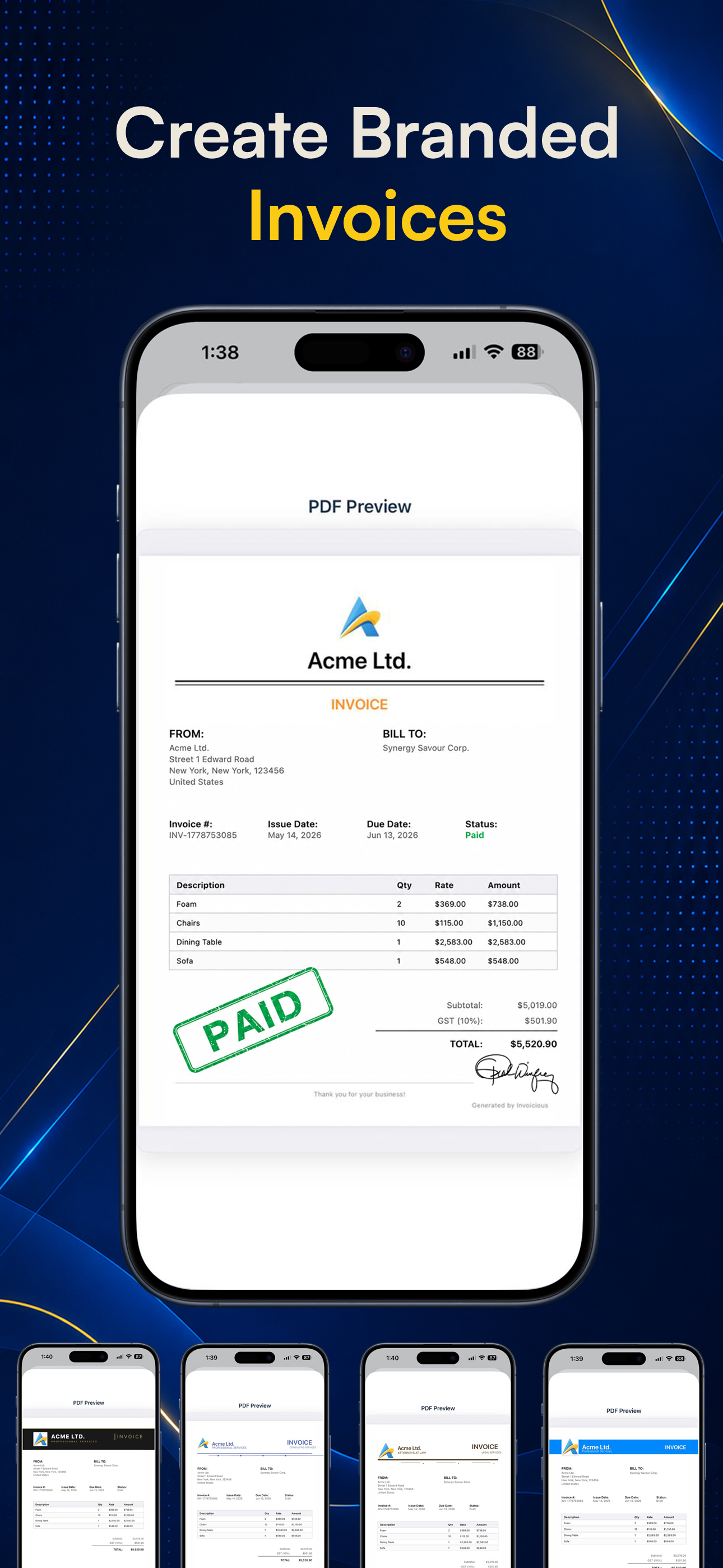
Put a due date on every invoice. With the Invoicious invoice generator you set the due date, send the invoice as a PDF from your iPhone or iPad, and track whether it's paid, unpaid or overdue.
Get Invoicious free