A deposit invoice is an invoice for part of the price of a job, sent before you start work or buy materials. It shows the full project total, the deposit percentage, the amount due now and how the balance will be billed. When the work is finished, your final invoice deducts the deposit already paid.
A deposit protects you if a client walks away after you've reserved time or bought materials. Here's when to ask, how much is typical, what to write and how the numbers work, using a $6,000 furniture order.
Key takeaways
- A deposit invoice bills an agreed share of the price before work starts, commonly 25% to 50%. The final invoice deducts it.
- Some places cap deposits. In California, most home improvement down payments are limited to $1,000 or 10% of the price, whichever is less.
- Put the amount, due date, balance and refund terms in writing, on the invoice and in your signed agreement.
- In accrual books, a deposit is a liability until you deliver. In the UK, VAT on it is usually due when it's paid or invoiced, whichever comes first.
What is a deposit invoice?
A deposit invoice is a normal invoice, with its own number, for a share of the agreed price. You send it when the client accepts your quote, so the money arrives before you commit time or materials. It's also called an upfront payment invoice or a down payment invoice.
It doesn't replace the final invoice, which still lists the full price and subtracts what's been paid. Both need the standard details covered in this guide to professional invoicing.
Deposit invoice, advance invoice or pre invoice?
An advance invoice usually means the same thing: a bill for payment before delivery, whether a deposit or the full price. "Pre invoice" is looser: some people mean a draft, others a proforma invoice, a preliminary bill the buyer uses to approve the price or arrange payment. A proforma usually isn't a valid tax invoice, so if a client pays against one, follow up with a proper invoice.
When to ask for a deposit
Ask for one whenever you'd lose money, or a booking you can't resell, if the client backed out after saying yes:
- Custom work. A logo, a website or a made-to-measure bookcase is worth little to anyone else.
- Materials. A deposit stops you from funding the client's stock, fabric or parts.
- Events and bookings. A wedding date or a photographer's Saturday is hard to rebook at short notice.
- New clients. With no payment history, a deposit tests whether they pay.
- Large projects. The deposit funds the start. For work in stages, progress billing usually beats one big deposit.
Small jobs and repeat clients who pay on time often don't need one. Whatever you decide, state the deposit in your quote. This explainer on quotes, estimates and invoices shows how the documents connect.
How much deposit to ask for
There's no universal standard. Start from what you'd lose if the client canceled: your upfront costs plus the time you've reserved. These are ranges you'll often see, not rules or legal limits:
| Type of work | Common practice | What it covers |
|---|---|---|
| Freelance design, writing and web projects | 25% to 50%, often 50% with new clients | Reserved time |
| Custom goods and furniture | 30% to 50%, or at least the cost of materials | Materials you can't resell |
| Events, weddings and photography | A flat booking fee or 25% to 50% | The date |
| Home improvement and construction | A smaller deposit, then progress payments; capped in some states | Start-up costs |
| Long, staged projects | A smaller deposit, then milestone invoices | The first stage |
Some trades and places cap deposits
Check the rules first, especially for work on people's homes. As of October 2026:
- California: a home improvement or swimming pool down payment can't be more than $1,000 or 10% of the contract price, whichever is less, with no exception for special-order materials, according to the Contractors State License Board. On a $6,000 job, that's $600. Contractors with a performance and payment bond or bond equivalent approved by the CSLB are exempt.
- Maryland: the Maryland Home Improvement Commission says a contractor can't accept more than one-third of the contract price as a deposit, or any payment before the contract is signed.
Other states, countries and trades set their own limits, so check with your licensing body or consumer protection agency.
Worked example: a 50% deposit invoice sample
Hollowbrook Furniture Co. quotes a new client, Copper Kettle Café, $6,000 for six oak tables and two benches (quote Q-0198), with 50% due on acceptance and the balance on delivery. Tax is shown at 10% to illustrate the math; use your own rate. The café accepts on November 2, 2026:
Deposit Invoice
No. INV-0207
Issue date: November 2, 2026
Due date: November 9, 2026
Hollowbrook Furniture Co.
52 Millrace Lane, Springfield
Copper Kettle Café
9 Market Street, Springfield
| Description | Qty | Unit price | Amount |
|---|---|---|---|
| 50% deposit, quote Q-0198: six oak tables and two benches (order total $6,000.00 + tax) | 1 | $3,000.00 | $3,000.00 |
Pay by November 9, 2026, to hold the November 16 build start, when the oak is ordered. Credited against the final invoice; the $3,000.00 + tax balance is invoiced on delivery, due in 14 days. Fully refundable if canceled in writing before November 16, 2026; after that, refundable less materials bought and work completed.
The café pays $3,300 on November 5, the build starts on November 16 and the furniture is delivered on December 14. The final invoice:
Invoice
No. INV-0215
Issue date: December 14, 2026
Due date: December 28, 2026
Hollowbrook Furniture Co.
52 Millrace Lane, Springfield
Copper Kettle Café
9 Market Street, Springfield
| Description | Qty | Unit price | Amount |
|---|---|---|---|
| Oak café table, made to order (quote Q-0198) | 6 | $750.00 | $4,500.00 |
| Oak bench, made to order | 2 | $750.00 | $1,500.00 |
Deposit of $3,300.00, including $300.00 tax, received November 5, 2026. Order total including tax: $6,600.00.
The final invoice lists the full order, names the deposit invoice and charges tax only on the $3,000 still owed, because the deposit was taxed on INV-0207.
If your tax isn't due until delivery, leave tax off the deposit invoice. The deposit is then $3,000, and the final invoice reads $6,000 + $600 tax − $3,000 = $3,600 due: the same $6,600 in total. These invoice templates give you a ready-made layout.
Deposit wording for the invoice and the email
Clear wording heads off disputes. Adapt these lines:
On the invoice
- Title: "Deposit Invoice" or "Invoice: 50% deposit".
- Line item: "50% deposit for six oak tables and two benches per quote Q-0198. Order total $6,000.00 + tax."
- Due date: "Due by November 9, 2026. Work starts on November 16 once the deposit is received."
- Credit: "This deposit will be credited against your final invoice."
- Refund terms: "Refundable in full if canceled in writing before work starts", "Refundable less the cost of materials ordered" or "Non-refundable once your date is reserved", whichever matches your signed agreement.
In the email
Subject: Deposit invoice INV-0207 to start building your tables
Hi Lena,
Thanks for approving quote Q-0198. Attached is deposit invoice INV-0207 for $3,300.00: the 50% deposit of $3,000.00 plus $300.00 tax.
Please pay by November 9, 2026, using the bank details on the invoice, to confirm your November 16 build start.
The deposit is credited against your final invoice, which I'll send on delivery. If you cancel in writing before November 16, I'll refund it in full.
Thanks,
Jonah Ellis
Hollowbrook Furniture Co.
Refundable vs non-refundable deposits
A refundable deposit goes back to the client if the job is canceled, often minus costs you've incurred. A non-refundable one is kept. The example uses a common middle ground: a full refund until materials are ordered, then a refund less costs.
Calling a deposit non-refundable doesn't guarantee you can keep it:
- Penalties don't hold up. US courts generally won't enforce a forfeit far above the loss you could reasonably expect; they can treat it as an unenforceable penalty clause.
- Consumer law can override your terms. The UK's Consumer Rights Act 2015 lists one-sided terms that let a trader keep a consumer's payments on cancellation, or demand a disproportionately high sum, as potentially unfair, and an unfair term is not binding on the consumer.
- Cancellation rights apply. Under the FTC's Cooling-Off Rule, a US consumer who buys at home for $25 or more, or for $130 or more at a temporary location such as a hotel, can generally cancel until midnight of the third business day for a full refund.
So tie any non-refundable part to real costs, and put it in the signed agreement as well as on the invoice.
This is general information, not legal advice. Rules vary by country and state, so check local law or ask a lawyer.
Deposit vs retainer vs advance payment vs prepayment
Clients use these words loosely. The difference is what the money buys and where it ends up.
| Factor | Deposit | Retainer | Advance payment | Prepayment |
|---|---|---|---|---|
| What it is | Part of a fixed price, paid to confirm the job | A fee to reserve your time, or funds drawn down as you bill | Any payment before delivery; the umbrella term | All or most of the price, paid before delivery |
| At the end | Deducted on the final invoice | Earned each period, or the unused balance is returned | Credited against the invoice | Final invoice shows little or nothing due |
| In your books | A liability until you deliver | Revenue over the period, or a liability until used | A liability until you deliver | A liability until delivery; the client books a prepaid asset |
How to record a deposit in your books
A deposit isn't revenue yet. Under IFRS 15, you recognize revenue when you transfer the promised goods or services; money received before then is a contract liability, often labeled deferred income, unearned revenue or customer deposits. In accrual books, the example posts like this:
- November 5: debit bank $3,300; credit customer deposits $3,000 and tax payable $300.
- December 14: debit customer deposits $3,000 and accounts receivable $3,300; credit revenue $6,000 and tax payable $300.
Revenue lands in December, when you deliver. With cash-basis books, you'd usually record the deposit as income when it arrives. Tax can differ: IRS Publication 538 says US cash-method businesses generally report income when received. Accrual-method businesses generally report advance payments in the year received but can elect to defer the unearned part to the next tax year, and no further. Ask your accountant about deposits that straddle year end.
Deposits and tax: when is VAT due?
In VAT systems, a deposit is often taxed upfront, not when the job is done:
- UK: HMRC says the tax point for a deposit is the date you issue a VAT invoice for it or the date you receive it, whichever comes first. If the client cancels and you keep the deposit, the VAT is still due. A returnable deposit on hired goods, refunded in full or kept to cover loss or damage, isn't subject to VAT.
- EU: under Article 65 of the VAT Directive, VAT generally becomes chargeable when a payment on account is received, on the amount received.
- US: there's no VAT, and sales tax rules on deposits are set by each state.
That's why the example taxes the deposit invoice. This is general information as of October 2026; rules vary by country, so confirm with your tax authority or an accountant.
Deposit invoices in Invoicious
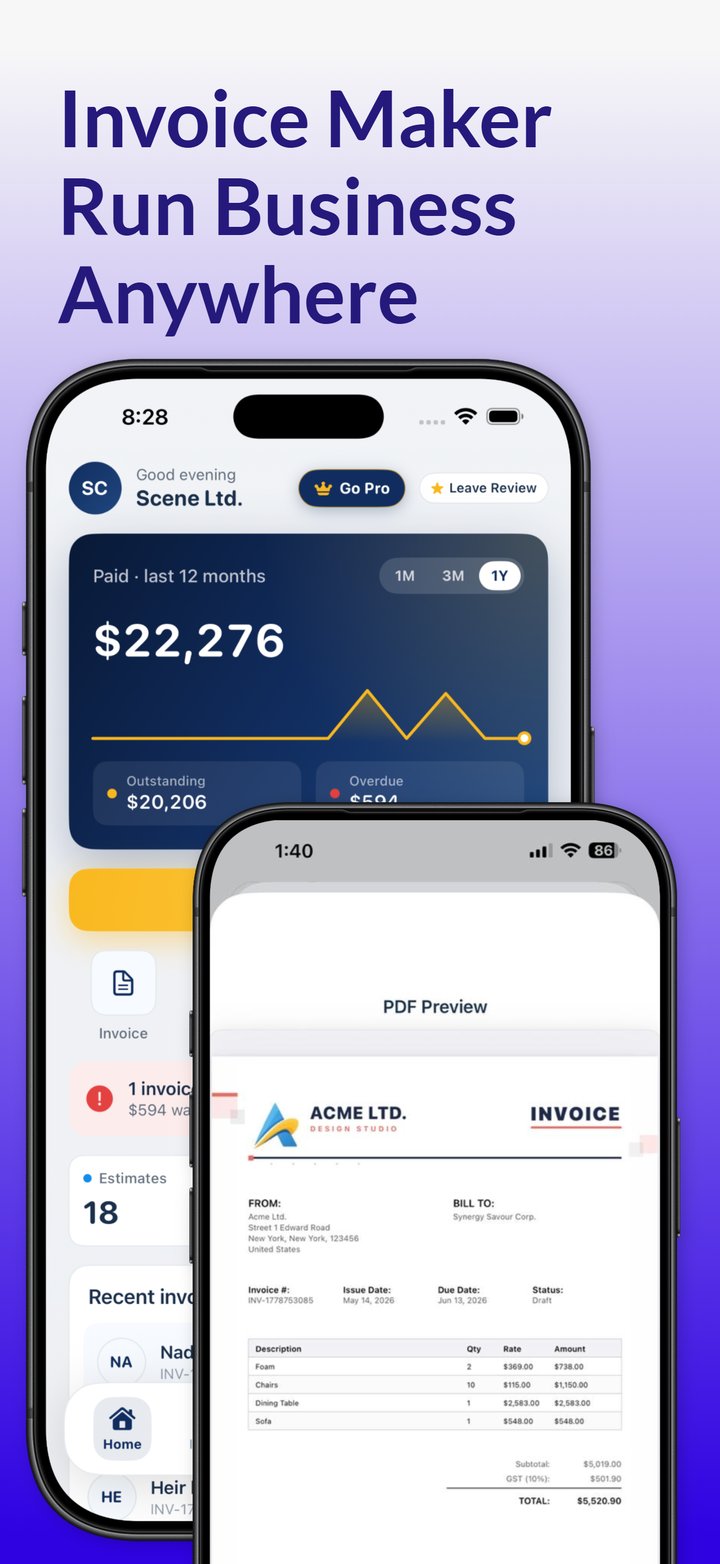
On iPhone and iPad, Invoicious covers this workflow. Create an estimate or quote with your logo, convert the estimate into an invoice when the client accepts, and send the deposit and the final bill as two separate invoices. Tax and discounts are calculated automatically, client details are saved for the final invoice, and documents go out as PDFs by email or Messages.
Tracking paid, unpaid and overdue status shows which deposit invoices are still outstanding, and the app generates a receipt once an invoice is paid. If a deposit runs late, this guide to collecting overdue invoices has reminder wording. The invoice and estimate maker page has more detail.
Send your next deposit invoice from your phone. Invoicious is free to download on iPhone and iPad, with optional Premium upgrades.
Get Invoicious free