Quote vs estimate vs invoice comes down to timing and price certainty. An estimate is an approximate price you give early, before the scope is settled. A quote is a fixed price for a defined scope that the client can accept. An invoice is the bill you send to get paid, after the work or at an agreed stage.
Mixing them up can lock you into a price you can't deliver for, or leave a client disputing a bill they never agreed to. And when a client asks for a "quote invoice", you need to know which document they actually want.
Key takeaways
- An estimate is a best guess that can change, a quote is a firm price for a set scope and period, and an invoice asks for payment.
- An accepted quote is often binding, depending on its wording and local law. An estimate isn't a fixed price, but the final bill should still be reasonable.
- Quotes and estimates don't go in your books; invoices and payments do.
- The usual order is estimate, quote, deposit, invoice, receipt. Small jobs often skip the estimate.
Estimate, quote and invoice: what each one means
Estimate: an educated guess
An estimate tells the client roughly what a job will cost, based on what you know so far. Use one when the scope isn't settled: a roof you haven't inspected, a website without a final page count. A range, such as $2,000 to $2,600, with a note on what could move the price, sets expectations better than a single number. In its guidance for England, Citizens Advice calls an estimate the trader's "best guess" at the cost.
Quote (quotation): a fixed-price offer
A quote, or quotation, states a specific price for a specific scope, usually with an expiry date. You send it once you know exactly what you're delivering. If the client accepts, that price is normally what you've both agreed to, so extra work needs a change order (a "variation" in Australia and New Zealand), not a surprise line on the invoice. Contractors may call it a bid, and agencies often fold it into a proposal.
Invoice (bill): the request for payment
An invoice, often just called a bill, asks the client to pay for work you've delivered, or for a deposit or stage you both agreed on. It carries a unique invoice number, an issue date, a due date and payment details.
Quote vs estimate vs invoice: side-by-side comparison
Here's how an invoice and quotation compare, with the estimate alongside:
| Factor | Estimate | Quote | Invoice |
|---|---|---|---|
| Purpose | A ballpark for budgeting | A firm price for a defined scope | Requests payment for work delivered or an agreed stage |
| Timing | Early, before the scope is final | Before work starts, once the scope is clear | After delivery, or at agreed milestones |
| Price certainty | Approximate, often a range | Fixed for the stated scope | The exact amount due |
| Binding? | Not a fixed price, but the final bill should be reasonable | Often binding once accepted, subject to its terms and local law | Bills what was agreed; it isn't the agreement itself |
| Validity | Short; costs and scope can move | Until the stated expiry date | No expiry; it has a payment due date |
| Accounting impact | None | None, even once accepted | A receivable when issued (accrual); income when paid (cash method) |
In accrual books, an invoice for delivered work is a debit to accounts receivable and a credit to revenue, as AccountingTools explains. On the cash method, income generally counts when you receive it, not when you bill it, as IRS Publication 538 sets out for US businesses.
From estimate to invoice: the usual workflow
People sometimes ask for an "estimate invoice" as if it were one document. It's really a chain, usually in this order:
- Estimate. The client asks what the job might cost. You reply with a range and your assumptions. Nothing is agreed yet.
- Quote. Once the scope is pinned down, you send a fixed price with an expiry date, payment terms and a way to accept: a signature, a reply email or a purchase order.
- Deposit. On acceptance, you send a deposit invoice for part of the total. In accrual books, a deposit you receive is recorded as a liability until you deliver, not as revenue.
- Invoice. When the work is done, the final invoice references the quote, adds any approved changes and subtracts the deposit. Long jobs often use progress billing instead, with an invoice at each stage.
- Receipt. When the client pays, you mark the invoice paid and issue a receipt showing the amount, date and payment method.
Not every job needs all five: a plumber fixing a leak may quote on the spot and invoice that afternoon. What matters is that each document matches the one before it, so the invoice never shows a price the client hasn't seen.
What is a quote invoice? Where a proforma fits
It isn't a standard document type. A client who asks for one, or for a "quotation invoice" or "quotation bill", usually means one of two things: the invoice you'll raise from the accepted quote, or a proforma invoice.
A proforma sits between the quote and the invoice. The US International Trade Administration calls it "a quote in an invoice format", which a buyer may need to apply for an import license, open a letter of credit or arrange payment.
It still isn't a real invoice. HMRC's VAT manual says a pro-forma is not an accounting document, has no place in either business's books and should preferably be marked "This is not a VAT invoice". After delivery, issue a proper invoice with its own number. For the format and a sample, see what a proforma invoice is and when to use one.
Is a quote legally binding?
Often, once the client accepts it, but it depends on the quote's wording and on local law.
Under general contract principles, a binding agreement forms when one party makes an offer and the other accepts it. Acceptance doesn't always need a signature: a client can state it, in an email or by telling you to start, or show it through conduct, such as paying your deposit.
A detailed quote usually works as that offer. New Zealand's Consumer Protection service calls a quote an offer to do a job for a specified price, which can't rise after acceptance unless the client agrees to extra work or the scope changes. Citizens Advice says much the same for England, adding that a trader can't charge more just because their costs have gone up.
The label alone doesn't decide it, though. In US government purchasing, the Federal Acquisition Regulation says a quotation is not an offer: the government's order is the offer, and a contract forms when the supplier accepts it.
Estimates give you more room, but not unlimited room. Citizens Advice says a customer can dispute a final bill that's a lot more than the estimate, and that the price should be "reasonable". New Zealand's guidance says it should generally be within 10 to 15% of the estimate.
Some trades have extra rules. California auto repair shops must give an estimate and get the customer's authorization before starting work and before any additional repairs (Bureau of Automotive Repair). Home improvement contractors there generally can't take a down payment of more than $1,000 or 10% of the contract price, whichever is less, and any price change needs a written change order (Contractors State License Board).
This is general information, not legal or accounting advice. Rules vary by country, state and trade, so check local regulations or ask a lawyer or accountant before relying on a quote's terms.
Examples: contractor, designer, consultant
Contractor: bathroom remodel
After a site visit, Diego, a remodeling contractor in Sacramento, tells a homeowner the job will likely run $18,000 to $22,000, depending on tile and fixtures. Once the client picks materials, he quotes $19,850, valid for 30 days. On acceptance he invoices the deposit, which California generally caps at $1,000 on a job this size, then invoices each stage as it's finished. A heated floor added mid-job becomes a signed $1,250 change order on the next invoice, and the final invoice shows a contract total of $21,100, less everything already paid.
Designer: brand identity
Designers often skip the estimate and quote a fixed fee per deliverable, stating the concepts and revision rounds included and an hourly rate for extras, because open-ended revisions are the real budget risk. The worked example below follows one such job.
Consultant: process review
A consultant who can't predict the hours sends an estimate instead: 30 to 40 hours at $150 an hour, or $4,500 to $6,000, with a $6,000 cap she can't pass without the client's sign-off. She then invoices monthly for actual hours, listing dates and tasks on an itemized invoice so the client can check progress against the estimate.
What each document should include
All of them share the basics: your business name and contact details, the client's details, a document number, a date and line items with prices. The differences:
- Estimate: the title "Estimate", the job as you understand it, a range or approximate total, your assumptions, what could change the price and how long the figure holds.
- Quote: the title "Quote" or "Quotation", a quote number, an expiry date, the scope and exclusions, the price with any tax shown, payment terms including any deposit, how changes are priced and how to accept.
- Invoice: the title "Invoice", a unique invoice number, issue and due dates, a reference to the quote or purchase order, what you delivered, tax, payments already received, the balance due and how to pay. The complete guide to professional invoicing covers each element.
- Receipt: the amount received, the payment date and method, and the invoice it settles.
Keep the branding and layout consistent so the client can see the invoice belongs to the quote they accepted. These professional invoice templates show a clean layout to start from.
Worked example: from quote to paid invoice
Ridgeway Design Co. quotes Bluebird Bakery for a brand identity. The bakery signs this quote:
Quote
No. Q-2026-031
Issue date: November 4, 2026
Valid until: December 4, 2026
Ridgeway Design Co.
210 Alder Street, Portland, OR
Bluebird Bakery LLC
45 Mill Road, Salem, OR
| Description | Qty | Unit price | Amount |
|---|---|---|---|
| Logo design: 3 concepts, 2 revision rounds | 1 | $1,800.00 | $1,800.00 |
| Brand style guide: colors, type, usage | 1 | $950.00 | $950.00 |
| Packaging label design, per size | 2 | $425.00 | $850.00 |
50% deposit ($1,710.00) due on acceptance. Balance due 15 days after final files are delivered. Revisions beyond the included rounds billed at $90 per hour. Prices exclude any applicable tax. To accept, sign and return this quote before the expiry date.
That one quote then produces four more documents:
| Date | Event | Document | Amount |
|---|---|---|---|
| Nov 6 | Bakery signs the quote | Deposit invoice INV-1042 (50%) | $1,710.00 |
| Nov 9 | Deposit paid | Receipt for INV-1042 | $1,710.00 |
| Dec 2 | Final files delivered, plus 3 extra revision hours the bakery requested | Final invoice INV-1057: $3,420.00 + $270.00 extra revisions − $1,710.00 deposit | $1,980.00 |
| Dec 12 | Balance paid | Receipt for INV-1057 | $1,980.00 |
Three details keep this clean. The final invoice references Q-2026-031, so the bakery can match it to what it signed. The extra hours appear as their own line at the rate the quote promised. And the deposit is shown as a payment received, not a discount, so both businesses record the same $3,690.00 job.
Estimates, quotes and invoices in Invoicious
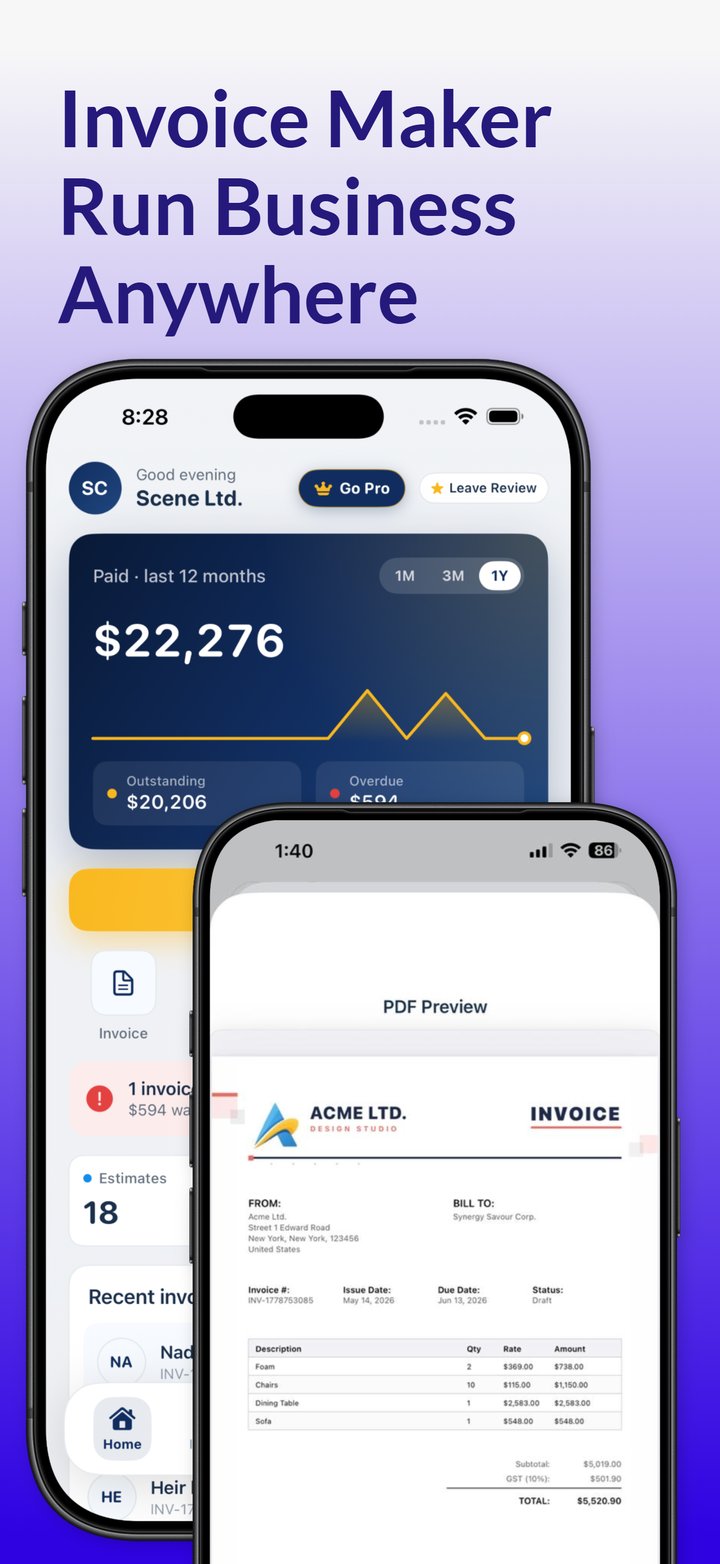
Invoicious, an invoicing app for iPhone and iPad, creates estimates, quotes and invoices with your logo and sends them as PDFs by email or Messages. When a client agrees to an estimate, you can convert it into an invoice, and once an invoice is paid, the app generates the receipt. Tax and discounts are calculated automatically, and you can see which invoices are paid, unpaid or overdue. It's free to download, with optional Premium in-app purchases; the invoice and estimate maker page has more detail.
Try it on your next quote. Invoicious is free to download on iPhone and iPad, with optional Premium upgrades.
Get Invoicious free