Progress billing is a way of invoicing a long project in stages, so the client pays for the work completed in each period instead of one lump sum at the end. Each progress invoice shows the contract total, what was billed before, what is billed now, any retainage withheld and the balance left to finish.
It's the usual way to bill construction, where you pay for labor and materials months before handover, and it suits other long projects too.
Key takeaways
- Progress billing splits one contract into a series of invoices, each for the work done since the last.
- Construction progress invoices usually follow a schedule of values: the price split into lines, each billed by percent complete.
- Clients often hold back retainage, a share of each payment, until the job is finished. Some laws cap it, such as 5% on many California and New York projects.
- Agree billing dates, retainage and payment terms in the contract before the first invoice.
What is progress billing?
Progress billing, also called progress invoicing, means billing a contract in parts as the work advances. Instead of one $100,000 invoice at handover, you send four or five, each for the work completed in that period.
US contractors often call each one a pay application. In the UK it may be called an interim application, and in Australia a progress claim.
Three ways to calculate a progress invoice
Percentage of completion
You bill the value of the work finished to date, minus what you billed before. If a $60,000 job is 40% complete ($24,000) and you billed $12,000 last month, this month's invoice is $24,000 − $12,000 = $12,000, before any retainage. Measure each line in ways the client can check on site, such as flooring laid or fixtures installed.
Milestone billing
You bill a fixed amount when a defined stage is reached: foundation poured, roof on, final inspection passed. Payment follows the event, not the calendar. Define each milestone precisely, because "nearly done" is where disputes start.
Time and materials at set intervals
When the scope is uncertain, you bill actual hours at agreed rates plus materials at cost or an agreed markup, every week or month. Timesheets and receipts are the backup, and many clients ask for a not-to-exceed cap.
The schedule of values
A schedule of values (SOV) splits the contract price into lines of work, each with a dollar value, adding up to the contract sum. Each progress invoice reports how complete every line is, so the client pays for measured work, not a round number.
Agree it before the first invoice, and avoid front-loading: putting extra value on early lines to get paid sooner. Owners and lenders look for it, and it can make later invoices harder to approve.
AIA G702 and G703: a common US format
US commercial jobs often use two American Institute of Architects forms. G702, Application and Certificate for Payment, is the summary: contract sum, change orders, work completed and stored to date, retainage, previous payments and the current payment due. The contractor fills it in, and the architect certifies to the owner how much is due.
G703, Continuation Sheet, holds the line-by-line detail from the schedule of values: previous applications, this period, stored materials, total to date, percent complete and balance to finish. Subcontractors use G702S and G703S.
You only need these forms if your contract calls for them. They're paid documents, licensed per use or by subscription, and the AIA doesn't publish a standard schedule of values form. Smaller jobs often use a plain progress invoice, like the sample below.
Retainage: the amount the client holds back
Retainage, called retention in the UK, Australia and New Zealand, is a percentage of each payment the client keeps until the job is complete or a defects period ends, as security that defects get fixed. For you, it's earned money you can't use yet, so track it as its own balance.
US legal limits (as of October 2026)
In the US, the contract sets the rate, within any legal cap. Some limits:
- Federal construction contracts: retainage isn't routine. Under FAR 32.103, it's only for unsatisfactory progress and can't exceed 10% of the approved estimate.
- California: 5% on public works (Public Contract Code §7201, with narrow exceptions) and, for contracts signed from January 1, 2026, on most private projects (Civil Code §8811). Purely residential projects of up to four stories are exempt from the private cap.
- New York: 5% on most private construction projects of $150,000 or more, for contracts signed from November 17, 2023, with release due within 30 days of final approval of the work (General Business Law §756-c).
Outside the US
UK retention is typically 5% of the contract value, often 3% on projects over £5 million, according to a 2021 Scottish Government working group report. The UK government has proposed banning cash retentions in construction. As of October 2026, the Commercial Payments Bill that would do it had reached third reading in the House of Lords on October 20 and still had to pass the House of Commons.
In England, Wales and Scotland, section 109 of the Construction Act gives a right to stage payments unless the parties agree the work will take less than 45 days. Contracts with homeowners for work on their own home are excluded. In New South Wales, Australia, security of payment law gives contractors a right to progress payments even if the contract says otherwise.
This is general information, not legal advice. Rules vary by country, state and project type, so check your contract and local law, or ask a construction lawyer or accountant.
Progress billing for construction: a worked $100,000 example
Cedar & Stone Contracting signs a $100,000 fixed-price contract to build out a dental office for Maple Street Dental, with a five-line schedule of values (shown in the sample invoice below). The contract sets monthly invoices over four periods, 10% retainage and payment within 30 days:
| Invoice | Previously billed | This period | Total to date | Retainage held (10%) | Amount due | Balance to finish |
|---|---|---|---|---|---|---|
| PB-1 | $0 | $20,000 | $20,000 | $2,000 | $18,000 | $80,000 |
| PB-2 | $20,000 | $25,000 | $45,000 | $4,500 | $22,500 | $55,000 |
| PB-3 | $45,000 | $34,000 | $79,000 | $7,900 | $30,600 | $21,000 |
| PB-4 | $79,000 | $21,000 | $100,000 | $10,000 | $18,900 | $0 |
| Retainage release | $100,000 | $0 | $100,000 | $0 | $10,000 | $0 |
| Total paid | $100,000 |
The PB-3 math, the way a G702 works it:
- Work completed to date: $79,000, or 79% of the contract.
- Less 10% retainage: $7,900, leaving $71,100 earned after retainage.
- Less amounts due on PB-1 and PB-2: $18,000 + $22,500 = $40,500.
- Amount due: $71,100 − $40,500 = $30,600.
- Balance to finish, including retainage: $100,000 − $71,100 = $28,900, the $21,000 of work left plus the $7,900 held back.
Working from totals to date stops one month's error from carrying into the next. When the client accepts the finished job, Cedar & Stone invoices the $10,000 retainage. Where retainage is capped at 5%, every holdback figure halves.
Sample progress billing invoice
Here's PB-3 as the client receives it:
Progress Invoice
No. PB-3
Issue date: November 30, 2026
Period to: November 30, 2026
Due date: December 30, 2026
Cedar & Stone Contracting
410 Quarry Lane, Springfield
Maple Street Dental LLC
22 Maple Street, Suite 200, Springfield
Project: Suite 200 build-out, contract of August 24, 2026
| Line of work | Scheduled value | Previously billed | This period | Total to date | Balance to finish |
|---|---|---|---|---|---|
| Demolition and site prep | $10,000 | $10,000 | $0 | $10,000 (100%) | $0 |
| Framing and drywall | $20,000 | $20,000 | $0 | $20,000 (100%) | $0 |
| Electrical and plumbing | $25,000 | $15,000 | $10,000 | $25,000 (100%) | $0 |
| Finishes | $30,000 | $0 | $21,000 | $21,000 (70%) | $9,000 |
| Fixtures and cleanup | $15,000 | $0 | $3,000 | $3,000 (20%) | $12,000 |
| Totals | $100,000 | $45,000 | $34,000 | $79,000 (79%) | $21,000 |
Retainage held to date: $7,900.00, payable on final acceptance. Balance to finish, including retainage: $28,900.00. Prices exclude any applicable tax.
What to include on a progress invoice
A progress invoice needs everything a normal invoice has (this guide to professional invoicing covers the basics), plus the contract figures:
- Identification: the title "Progress invoice", invoice number, stage or application number, issue date, billing period and due date.
- Project: both parties' details, the project name or address and the contract date.
- Contract sum: the original amount, approved change orders and revised total.
- Lines: scheduled value, previously billed, this period, total to date, percent complete and balance to finish. An itemized invoice layout works well.
- Retainage and amount due: the rate, the total held to date and what's due after previous invoices.
- Terms and backup: how and when to pay, plus any photos, inspection reports or lien waivers the contract requires. In California, a conditional lien waiver for a progress payment must be in substantially the form set out in Civil Code §8132.
Progress billing vs deposit vs milestone billing
They're often combined: a deposit invoice at signing, then progress or milestone invoices that deduct it as the contract specifies.
| Factor | Progress billing | Deposit | Milestone billing |
|---|---|---|---|
| Bills for | Work completed in each period | Commitment before work starts | Reaching a defined stage |
| When | Set dates, often monthly | Once, at signing | When each milestone is met |
| Amount | Value of work done this period, less retainage | Fixed sum or share of the price | Fixed sum or share per milestone |
| Main friction | Agreeing percent complete | Client pays before seeing work | Deciding if a milestone is done |
Pros and cons for contractors and clients
| Party | Advantages | Drawbacks |
|---|---|---|
| Contractor | Cash arrives while costs are incurred; smaller invoices are easier to approve; you learn early if a client can't pay | Paperwork every period; retainage ties up profit; each payment waits on the client's review |
| Client | Pays only for work in place; sees spending against budget; retainage keeps a hold until the punch list is done | Must check every invoice; needs someone to judge percent complete; pays throughout the job |
One accounting note: billing decides when you get paid, not when you've earned the money. In accrual books, revenue on long contracts generally follows progress on the work under IFRS 15 and its US counterpart, ASC 606, so billed and earned amounts can differ at month-end.
Progress invoicing beyond construction
Any long, fixed-price project can be billed this way. A web agency building a $24,000 site might bill monthly by share completed: at 40% done by the end of March, the March invoice is $9,600, less anything billed earlier. Agree what counts as progress, and show the running total on every invoice.
Tips for getting progress invoices paid on time
- Agree the schedule in the contract: billing dates, method, schedule of values, retainage and release terms, review period and payment terms. Settle the price first with a quote or estimate.
- Document completion with dated photos, inspection reports and delivery tickets, so percent complete is quick to verify.
- Bill on the agreed date. Many clients approve invoices on a monthly cycle, so a late invoice can wait a full extra period.
- Keep change orders separate, as their own lines and only once approved.
- Chase retainage like any other invoice as soon as the contract allows its release.
- Follow up early. A polite reminder a few days after the due date is easier to answer than a final notice at 60 days. Here's how to collect overdue invoices.
Progress invoicing in Invoicious
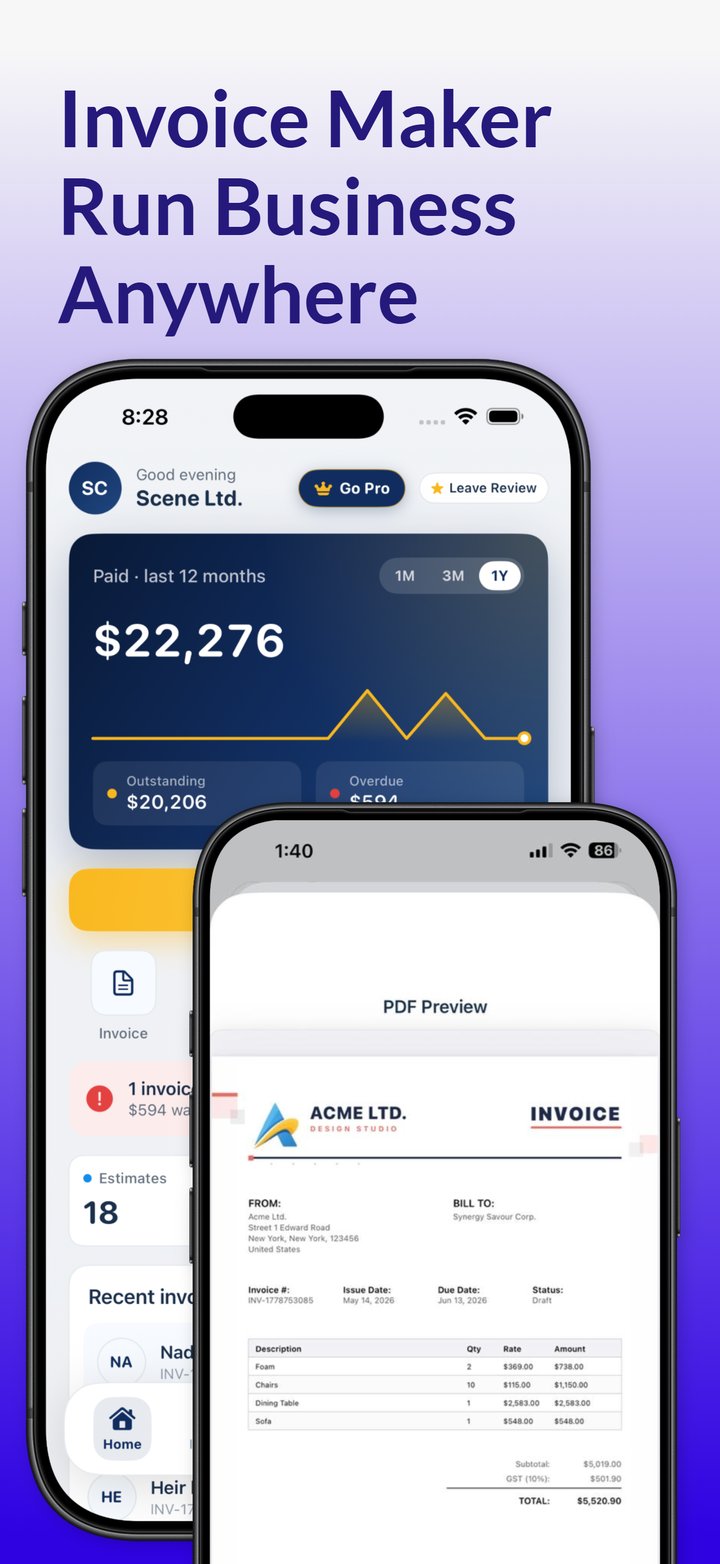
In Invoicious on iPhone or iPad, you create one invoice per stage. When the next stage is due, duplicate the previous invoice, update the amounts and send it as a PDF by email, Messages or another app. The app doesn't calculate retainage or produce a schedule of values or AIA forms, so work those figures out as in the example above.
Each invoice is tracked as paid, unpaid or overdue, so you can see which stages the client still owes, and the app generates a receipt once an invoice is paid. It works offline and is free to download, with optional Premium in-app purchases. See the invoice generator for iPhone and iPad and the invoice templates you can brand with your logo.
Bill each stage from your iPhone. Duplicate the last invoice in Invoicious, update it and send it as a PDF.
Get Invoicious free