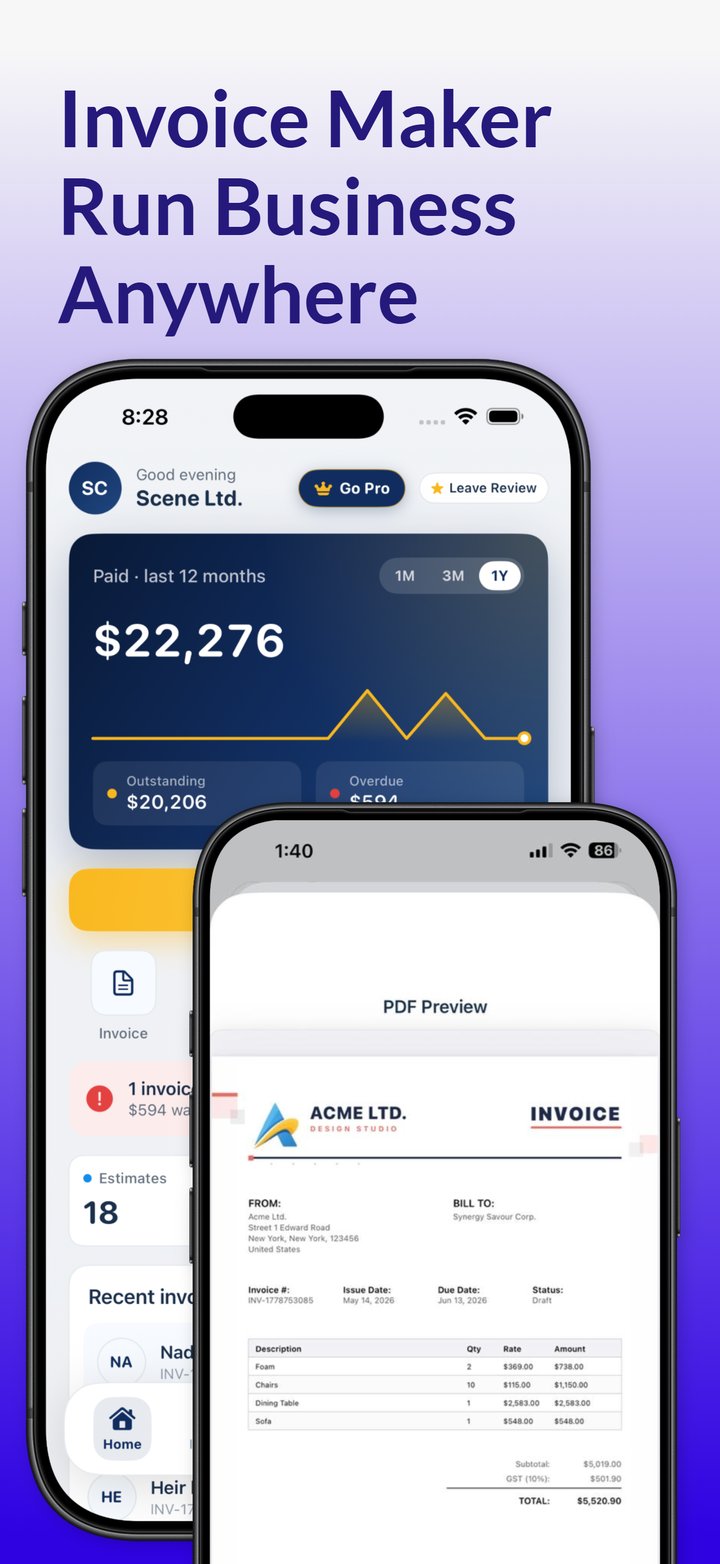
An itemized invoice is a bill that lists every product, service and fee on its own line, with a description, quantity, rate and amount for each, followed by any discounts, tax and the total. It lets your client, or their insurer or employer, check exactly what they are paying for instead of trusting a single lump sum.
Insurers, employers and careful clients ask for one, and some trades must itemize by law.
Key takeaways
- An itemized invoice gives each task, product and fee its own line: date, description, quantity, unit, rate, any discount, tax treatment and amount.
- Insurance claims, auto and medical bills, contractor jobs and expense claims all call for one. California requires it for auto repairs.
- Keep labor, materials and reimbursable expenses on separate lines. Tax rules often treat them differently.
- Apply discounts before tax, and write descriptions a stranger could check: what was done, to what, when and how much.
What is an itemized invoice?
An itemized invoice, also called a detailed invoice or itemized bill, shows its total as the sum of separate, priced lines. Each line names one product, task or fee and shows how its amount was reached, usually quantity times rate.
Itemizing is a level of detail, not a document type: a sales invoice for goods or a service invoice can be itemized. The opposite is a summary, or lump-sum, invoice with one figure for the whole job.
When you need an itemized invoice
Insurance claims
The NAIC, the association of US state insurance regulators, tells homeowners to keep receipts for extra living costs because the insurer will need them to reimburse you. For repairs, a line for each part and task is easier for an adjuster to check against the insurer's estimate than a single total. Add the claim number.
Auto repair
In California, Business and Professions Code section 9884.8 requires auto repair invoices to list service work and parts separately, give a subtotal for each, show sales tax separately and say when a part is used, rebuilt or reconditioned. The state's invoice regulation also bans separate charges for items noted only as "shop supplies" or "miscellaneous parts". A San Mateo County Superior Court guide sums up these rights. Elsewhere, the same layout answers the questions customers and insurers ask first.
Medical bills
The US Centers for Medicare & Medicaid Services tells patients to ask for a detailed bill listing the cost of each item or service. Medicare patients have a legal right to one for Medicare-paid care: a provider must furnish an itemized statement within 30 days of a written request, or face a civil money penalty for each knowing failure (42 U.S.C. § 1395b-7).
Contractors and trades
Time-and-materials jobs and change orders need line-level detail, because the client pays for what was actually used. Show labor by task, and give materials, equipment rental, permits, subcontractors and disposal their own lines.
Expense reimbursement
Anyone reimbursing a cost needs proof they can file. IRS Publication 463 tells US employees to give their employer the same type of records the IRS would want, showing the amount, date, place and essential character of each expense. A hotel receipt, for example, should show separate amounts for lodging, meals and phone calls.
Client transparency
Most itemized invoices aren't required by anyone. They're sent because a client who sees hours, quantities and rates can question one line instead of the whole bill.
Invoice details: what each line item needs
Each line should answer five questions: what, when, how many, at what price and with what tax. Examples are from one labor line in the sample below.
| Field | What it shows | Example |
|---|---|---|
| Date | When the work was done or the goods delivered | Oct 6, 2026 |
| Description | What you supplied, specific enough to check | Replace both shut-off valves and supply lines under kitchen sink |
| Quantity | How many units | 1.5 |
| Unit | What one unit is | hr (or ea, sq ft) |
| Rate | Price per unit, before tax | $85.00 |
| Discount | Any reduction, with the reason | 10% repeat-client discount on labor, shown in the totals |
| Tax | Whether tax applies, and at what rate | None: Texas doesn't tax home repair labor |
| Amount | Quantity times rate, less any line discount | $127.50 |
The invoice also needs the usual header details: both parties' names and addresses, a unique invoice number, issue and due dates, payment terms and any PO or claim reference. The complete guide to professional invoicing covers each one.
Itemized invoice example
Here is an itemized invoice from a fictional plumbing and repair business in Austin, Texas. Its client, Priya Nair, will send it to her home insurer.
Invoice
No. INV-2026-0187
Issue date: October 8, 2026
Due date: October 22, 2026
Insurance claim: HO-58213
Oakline Plumbing & Repair
418 Alder Street, Austin, TX
Priya Nair
27 Willow Court, Austin, TX
| Date | Description | Qty | Unit | Rate | Amount |
|---|---|---|---|---|---|
| Labor | |||||
| Oct 6 | Find leak; remove water-damaged sink-base floor | 2.5 | hr | $85.00 | $212.50 |
| Oct 6 | Replace both shut-off valves and supply lines under kitchen sink | 1.5 | hr | $85.00 | $127.50 |
| Oct 7 | Replace 16 sq ft of wet drywall behind sink; tape and finish | 3 | hr | $85.00 | $255.00 |
| Materials (taxable) | |||||
| Oct 6 | Quarter-turn shut-off valve, 1/2 in. × 3/8 in. | 2 | ea | $14.50 | $29.00 |
| Oct 6 | Braided stainless supply line, 20 in. | 2 | ea | $9.75 | $19.50 |
| Oct 6 | Sink-base floor panel, 3/4 in. plywood, cut to fit | 1 | ea | $42.00 | $42.00 |
| Oct 7 | Moisture-resistant drywall, 1/2 in., 4 × 8 ft sheet | 1 | ea | $18.90 | $18.90 |
| Oct 7 | Joint compound and tape | 1 | lot | $16.40 | $16.40 |
| Reimbursable expenses (at cost) | |||||
| Oct 6 | Plumbing permit fee, paid on client's behalf (receipt #44817 attached) | 1 | ea | $65.00 | $65.00 |
Payment due within 14 days. Permit receipt attached.
How the numbers work
- Labor: 2.5 + 1.5 + 3 = 7 hours at $85, or $595.00. The 10% repeat-client discount applies to labor only: $59.50.
- Materials: five lines, $125.80 in total.
- Expense: the $65.00 permit fee is passed on at cost, with the receipt.
- Tax: 8.25% of $125.80 is $10.38. Texas doesn't tax labor to repair a home, and a contractor who bills materials separately collects state and local tax on the materials at the job site's rate. In Austin that is 8.25%: 6.25% state, 1% city and 1% transit authority. The discount comes off untaxed labor, so it doesn't change the tax.
- Total: $726.30 subtotal plus $10.38 tax gives $736.68.
To skip the layout work, start from one of these professional invoice templates.
Itemized vs summary invoice: when a detailed invoice is worth it
| Aspect | Itemized invoice | Summary invoice |
|---|---|---|
| What it shows | Each task, product and fee, with quantity, rate and amount | One figure, or a few, for the whole job or period |
| Best for | Repairs, insured or reimbursed work, time-and-materials jobs, new clients | Fixed-price work agreed in detail beforehand, retainers |
| How the client checks it | Line by line, against the quote, work order or receipts | Against the agreed price |
| As a VAT or GST invoice | Already shows quantities, prices and rates | May need more detail to qualify |
| Effort | More, unless lines come from the quote | Less |
A middle ground is a summary invoice with an itemized attachment, such as a timesheet.
Bad vs good line descriptions
| Vague | Specific |
|---|---|
| Services rendered | Replace kitchen shut-off valves and supply lines, Oct 6 (1.5 hr) |
| Consulting, March | Pricing workshop with sales team, Mar 4 and Mar 11 (2 sessions × 3 hr) |
| Design work | Homepage and four inner-page layouts, two revision rounds, per quote Q-2026-031 |
| Brakes | Part: front brake pads, new (1 set). Labor: fit pads and resurface both front rotors (1.2 hr) |
| Misc. fees | Plumbing permit fee, paid on client's behalf, at cost (receipt attached) |
A good description tells someone who wasn't there what was done, to what, when and in what quantity. If the work came from a quote or purchase order, include its number.
Materials vs labor: keep them on separate lines
Separate lines let the client check your hours against the quote, let an insurer match each part to its estimate, and let the right tax apply, since many places tax the two differently.
California's tax agency, for example, says tax generally doesn't apply to itemized charges for labor to repair goods, such as a car. When parts are more than 10% of the total charge, the repairer must show parts and labor separately on the invoice and charge tax on the parts. If you mark up materials, say so in the quote.
Discounts, per-line tax and reimbursable expenses
Discounts
Label each discount and say what it applies to, such as "10% off labor", then apply it before tax. In the UK, VAT on a sale with an unconditional discount is based on the discounted amount, while a discount that depends on a later event counts only once it's earned. Article 79 of the EU VAT Directive keeps discounts given at the time of supply out of the taxable amount. So $1,000 of taxable goods with a 10% discount and 8% tax is taxed on $900: $72 tax, $972 total.
Per-line tax
One invoice can mix taxable, exempt and reduced-rate lines, and VAT and GST rules expect that to show. A full UK VAT invoice must show the unit price and, for each description, the quantity, VAT rate and amount excluding VAT (VAT Notice 700/21). EU VAT invoices must show the unit price excluding VAT and the taxable amount per rate (Article 226 of the VAT Directive). Australian tax invoices must show the extent to which each sale is taxable. Country details are in what makes a tax invoice valid.
Reimbursable expenses
Costs you pay on the client's behalf, such as permits, disposal or courier fees, get their own lines, at cost or with an agreed markup, backed by the receipt. In the UK, a payment is a disbursement outside VAT only if it meets HMRC's conditions, including showing it separately and passing on the exact amount. Your own business costs, such as a flight to a job, are "recharges" even when listed separately, and you charge VAT on them.
Tax rules vary by country, state and type of job, so treat this as general information and check with your tax authority or an accountant.
How to make an itemized invoice
- Start from the agreement. Copy the lines from the quote or estimate you sent, then add any approved changes.
- Split the job. One line per task, product or fee, grouped as labor, materials and expenses.
- Fill in each line. Date, description, quantity, unit and rate. Check that quantity times rate equals the amount.
- Apply discounts with a label, before tax.
- Work out the tax line by line, marking any line that isn't taxed.
- Finish and send. Add the references, attach expense receipts, check the total and send a PDF.
If you work in spreadsheets, an Excel invoice template with line-item formulas saves doing the math by hand.
Template: how to ask a vendor for an itemized invoice
If you're the customer and the invoice shows one total, send this:
Subject: Itemized invoice needed for invoice #[number]
Hi [name],
Thanks for the work on [date]. My [insurer / employer] needs an itemized invoice to process my [claim / expense report], and the one I have shows a single total. Could you send a version that shows:
- each service, part or product on its own line, with the date
- the quantity and price for each line, including hours and hourly rate for labor
- labor, materials and any fees listed separately
- any discount, plus the tax rate and amount
- your business name and address, and my reference [claim or PO number]
The total doesn't need to change. A PDF by email is fine.
Thanks,
[Your name]
Itemized invoices in Invoicious
Invoicious is an invoicing app for iPhone and iPad. You add line items with quantities and prices, the app applies discounts and calculates tax automatically, and you send the invoice as a PDF by email, Messages or another app. It also saves client details and shows which invoices are paid, unpaid or overdue. It's free to download, with optional Premium in-app purchases; the free invoice generator for iPhone page describes its features.
Build itemized invoices on your iPhone. Add each item with its quantity and price, and Invoicious works out the discount and tax.
Get Invoicious free