A digital invoice is any invoice you create and send electronically, usually a PDF attached to an email or message. A structured e-invoice is machine-readable data in a standard format such as UBL, sent straight from your software to your client's, often over the Peppol network or through a government platform.
The difference matters because more countries now require structured e-invoices between businesses, and there a PDF no longer counts. This guide compares the formats, explains when a handwritten invoice is still fine, summarizes the main mandates and sets out steps to go paperless.
Key takeaways
- A PDF invoice is digital, not structured. A structured e-invoice is data, in a format such as UBL or CII, that software reads without retyping.
- Where no mandate applies, handwritten and PDF invoices are still valid if they show the required details.
- Belgium, Poland, France, Germany, Saudi Arabia, India and Malaysia already require some or all businesses to send or receive e-invoices. The UAE starts in January 2027, the UK in April 2029 and EU cross-border rules in July 2030.
- Invoicious makes PDF invoices. It doesn't create structured e-invoices or connect to Peppol, ZATCA or other government systems.
Digital invoice vs e-invoice: what's the difference?
A digital invoice is a document for people. You make it in an app, template or spreadsheet, save it as a PDF and send it by email or message. Your client reads it, and their accounts team may retype the details. Current EU VAT law still calls that an electronic invoice, because the VAT Directive accepts invoices issued and received "in any electronic format".
A structured e-invoice is data for software. Every detail, from your tax number to each line's tax rate, sits in a labeled field. In Europe, the standard EN 16931 defines those fields and carries them in one of two XML formats, UBL or UN/CEFACT CII. Peppol is a network and set of specifications for exchanging such files. Your client's system books it without retyping, and some countries require it to pass through, or be reported to, a government platform.
A quick test: if a person has to read your invoice to enter it, it's a digital invoice. If software can process it untouched, it's a structured e-invoice. Hybrid formats such as Factur-X and ZUGFeRD embed the data inside a PDF, so one file serves both.
Paper vs PDF vs structured e-invoice compared
| Paper or handwritten | PDF or emailed invoice | Structured e-invoice | |
|---|---|---|---|
| Made for | People | People | Software |
| How it's created | By hand in an invoice book, or printed | Invoice app, template or spreadsheet | Software that outputs UBL, CII or a national format |
| How it travels | By hand or post | Email, messaging apps or client portals | Peppol or another network, sometimes via a government platform |
| What your client does | Types it in | Types or scans it in | Imports it automatically |
| Where no mandate applies | Valid if it shows the required details | Valid if it shows the required details | Valid, usually by agreement with your client |
| Sales covered once a mandate fully applies | Not accepted | Not accepted | Required |
Are handwritten or manual invoices still acceptable?
In many places, yes. Most tax authorities care about what an invoice says, not how it was produced. In the US, the IRS lets you choose any recordkeeping system that clearly shows your income and expenses. In the UK, HMRC says you don't have to keep records in a set way, although VAT-registered businesses must keep certain records in compatible software under Making Tax Digital.
A handwritten invoice stops being acceptable once an e-invoicing mandate covers the sale. Saudi Arabia was early: since December 4, 2021, ZATCA has required in-scope taxpayers to stop issuing handwritten invoices, or invoices made in word processors or spreadsheets. Belgium and Poland now apply similar rules to most sales between businesses.
What a manual invoice must include
Rules vary, but a handwritten invoice that would pass in most countries shows:
- The word "Invoice", or "Tax invoice" where required
- A unique number that follows on from the last one
- The issue date, and the supply date if different
- Your name, address and any VAT or GST number, plus your client's name and address (and tax number where required)
- A description, quantity and price for each item
- Any tax rate and tax amount, the total due, and payment terms
Write in ink, use a duplicate invoice book so you keep an identical copy, and never erase a mistake: void the invoice and issue a new one. See how to number invoices, what makes a tax invoice valid and our step-by-step invoicing guide.
Benefits of paperless invoicing
Going digital pays off even where no mandate applies:
- Faster payment. An emailed invoice arrives in seconds, the day you finish the job.
- Fewer errors. Software calculates totals, tax and discounts, with no handwriting to misread.
- Easier follow-up. You can search every invoice and see what's paid, unpaid or overdue. Here's a simple way to track invoices.
- Lower costs and better records. No printing or postage, and digital copies are easy to back up and share with an accountant.
- A head start. If a mandate reaches you or your clients, you already have digital habits to build on.
Structured e-invoicing adds automation. The European Commission expects the EU's move to e-invoicing to cut EU traders' administrative and compliance costs by over €4.1 billion a year over the next ten years.
E-invoicing mandates by country, as of October 2026
Here's where the main mandates stand as of October 2026, checked against each government's own publications. Most apply to businesses established or registered in that country, and many cover only sales to other businesses.
| Country | Who's affected | Key dates | Official source |
|---|---|---|---|
| European Union (ViDA) | Businesses selling to businesses in other EU countries | Adopted March 11, 2025, in force April 14, 2025, letting EU countries introduce domestic mandates under specific conditions. E-invoice-based digital reporting for cross-border B2B sales from July 1, 2030. | European Commission |
| Belgium | VAT-registered businesses established in Belgium, for invoices to each other | Structured e-invoices via Peppol required since January 1, 2026. The first-quarter penalty tolerance ended March 31, 2026. Invoices to private individuals are excluded. | Belgian government e-invoice portal, tolerance notice |
| Poland | VAT taxpayers, through the national KSeF system | All must receive through KSeF since February 1, 2026. Issuing: since February 1, 2026 for 2024 sales over PLN 200 million (including VAT), since April 1, 2026 for the rest. Businesses invoicing PLN 10,000 (gross) a month or less may issue invoices outside KSeF until the end of 2026. | Ministry of Finance (in Polish) |
| France | Businesses established in France and subject to VAT, including micro-entrepreneurs | From September 1, 2026, all had to be able to receive e-invoices, and large and mid-sized companies had to issue them. From September 1, 2027, small and micro businesses must issue them. Invoices go through an approved platform. E-reporting of other sales, such as to consumers, follows the same dates. | impots.gouv.fr (in French) |
| Germany | Businesses established in Germany, for domestic B2B sales | All must be able to receive e-invoices since January 1, 2025. Paper or PDF invoices (PDF with the client's consent) remain allowed through 2026, and in 2027 only for businesses with prior-year turnover of €800,000 or less. The transition ends December 31, 2027. | Federal Ministry of Finance, VAT Act § 27(38) (in German) |
| Saudi Arabia | Resident VAT taxpayers | Phase 1 (e-invoice generation) since December 4, 2021. Phase 2 (integration with ZATCA's FATOORA platform) in waves since January 1, 2023. Wave 25, for VAT-able revenue over SAR 187,500 in any year from 2022 to 2025, must integrate by February 1, 2027. | ZATCA phases, Wave 25 |
| United Arab Emirates | Businesses and government entities. Sales to consumers are excluded for now. | Voluntary use began July 1, 2026. Revenue of AED 50 million or more: had to appoint an Accredited Service Provider by October 30, 2026, and must go live by January 1, 2027. Smaller businesses: appoint by March 31, 2027, go live by July 1, 2027. Government entities: by October 1, 2027. | UAE Ministry of Finance |
| India | GST-registered businesses whose aggregate turnover exceeded ₹5 crore in any financial year since 2017-18, with some sectors exempt | Must report B2B invoices to an Invoice Registration Portal since August 1, 2023, when the threshold fell from ₹10 crore. | Notification 10/2023-Central Tax |
| Malaysia | Businesses with annual turnover of RM3 million or more, through MyInvois | Phased in from August 1, 2024 (over RM100 million) to January 1, 2026 (up to RM5 million). Turnover below RM3 million is exempt (timeline updated August 30, 2026), unless a shareholder or group company reaches RM3 million. An interim relaxation for the up-to-RM5 million group, allowing consolidated e-invoices, runs to December 31, 2027. | Inland Revenue Board of Malaysia, FAQ (PDF) |
More are coming: the UK will introduce e-invoicing requirements for VAT invoices from April 1, 2029. HMRC and the Department for Business and Trade published the implementation roadmap with Budget 2026 on October 28, 2026.
Selling only to consumers? Check anyway. Saudi Arabia's mandate covers simplified tax invoices, France's e-reporting reaches sales to individuals, and even consumer-only businesses in Belgium and France must be able to receive e-invoices from their suppliers.
Mandates change often. Dates and thresholds can move at short notice. Treat this table as general information, not tax advice, and confirm what applies to you with your tax authority or an accountant.
How to go digital: practical steps
- Check whether a mandate covers you. Consider where you're established, your turnover and who you sell to, and ask your accountant if you sell to businesses in a mandate country.
- If none applies, pick one invoicing tool. An invoice generator app or a ready-made invoice template keeps layout, numbering and tax calculations consistent.
- Set up your details once: business name, address, tax number, logo, payment details and default terms. Continue your existing invoice number sequence.
- Send PDFs properly. Name the file clearly and put the invoice number in the subject line. Here's how to format an invoice email.
- If a mandate applies, use a compliant e-invoicing solution: Peppol-connected software in Belgium, an EN 16931 format such as XRechnung or ZUGFeRD in Germany, an approved platform in France, KSeF-connected software in Poland, a solution that meets ZATCA's requirements in Saudi Arabia, an Accredited Service Provider in the UAE, an Invoice Registration Portal in India or MyInvois in Malaysia.
- Switch over carefully. Confirm clients receive and pay your first digital invoices, and keep old paper records for the full retention period.
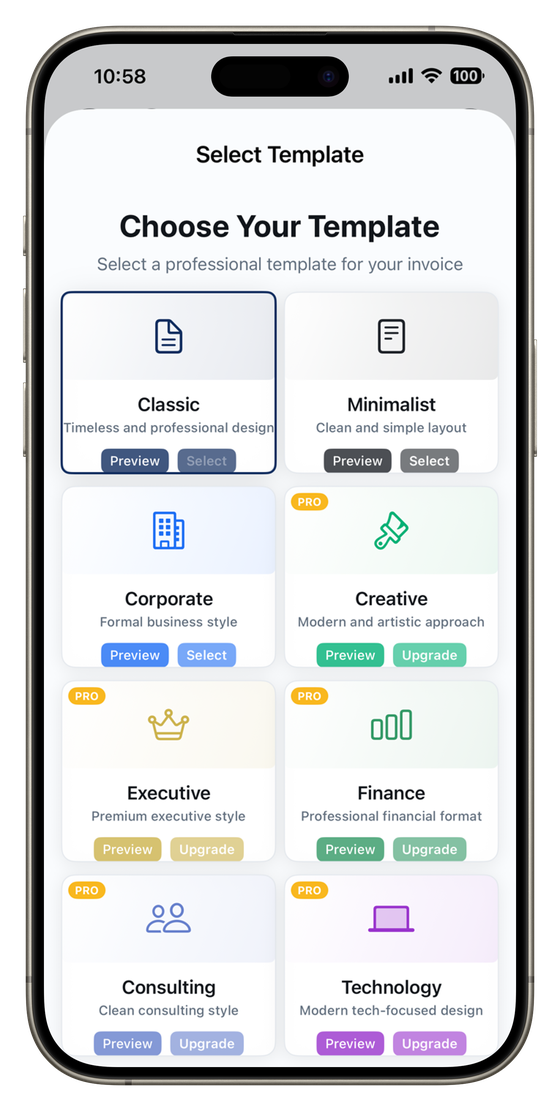
Send professional PDF invoices from your iPhone or iPad. Invoicious has templates with your logo, automatic tax and discount calculations, multi-currency support, saved client details and paid, unpaid and overdue tracking, and it works offline.
Get Invoicious freeStoring digital invoices: security and retention
Whatever the format, each invoice must stay readable and unchanged for years. EU law, for example, requires the authenticity of origin, integrity of content and legibility of every invoice, paper or electronic, until its storage period ends (Article 233 of the VAT Directive).
- Keep the original PDF or e-invoice file as sent or received. Keep paper invoices unless your tax authority accepts scans, as HMRC does when the image shows all the VAT details.
- Back up in two places, such as your device and a cloud service or an external drive.
- Lock down access with a device passcode, unique passwords and two-factor authentication on email and cloud accounts.
- File consistently, with names such as INV-2026-0042_ClientName.pdf in a folder for each tax year.
- Watch for invoice fraud. If a supplier emails new bank details, confirm them by phone, using a number you already have, before paying.
How long you must keep invoices depends on the country and the tax, and company law may require longer. Our guide to paid invoices covers how long to keep invoices and payment records.
Where Invoicious fits (and where it doesn't)
Invoicious is an invoicing app for iPhone and iPad that creates PDF invoices, estimates and receipts and sends them by email or Messages. That's digital invoicing, and it's enough wherever no e-invoicing mandate applies. It doesn't create UBL or Peppol files or connect to the Peppol network or to government systems such as ZATCA's FATOORA platform, KSeF or MyInvois, so use a compliant e-invoicing solution for any sales a mandate covers.