An invoice number, also called an invoice ID, is the unique reference that identifies one invoice and no other. It's how you, your client and a tax inspector find, match and check that invoice. Under UK and EU VAT rules and India's GST rules, invoice numbers must also run in sequence.
Key takeaways
- An invoice number (invoice ID) identifies one invoice. Show it on the invoice, in the email subject and in the payment reference.
- UK, EU and Indian rules require unique, sequential numbers. Letters, prefixes and more than one series are allowed.
- Start at any number, such as 1001, then count up without skipping, reusing or deleting numbers.
- Cancel mistakes with a credit note from its own series, keep voided invoices and note the reason for any gap.
What is an invoice number (invoice ID)?
An invoice number is the reference you give an invoice when you issue it, and it stays with that invoice for good. Invoice ID, invoice no., invoice # and, in South Asia, bill number all mean the same field.
It can be plain digits, such as 1042, or mix letters, digits and separators, such as INV-2026-0042. It's one of several details every invoice needs, and the invoicing guide covers the rest.
Why invoice numbers matter
- Matching payments. When a client quotes the number as the payment reference, you can match the money to the right invoice at a glance.
- Audits. Tax inspectors can check the sequence for missing numbers. A gap you can explain is routine. One you can't looks like an unrecorded sale.
- Finding documents. One search pulls up the invoice, its emails and the payment. Many accounts payable teams also check invoice numbers to avoid paying a bill twice.
Do invoice numbers have to be sequential? What the tax rules say
Under UK and EU VAT rules and India's GST rules, yes. Elsewhere it varies. Here's where the main rules stand as of October 2026.
United Kingdom
A full VAT invoice must show “a sequential number based on one or more series which uniquely identifies the document” (VAT Notice 700/21, section 4.1). HMRC's VAT Trader Records manual adds that numbers can mix letters and digits, you can start above 1 and run several sequences at once, and a break is acceptable if you keep the canceled or spoiled invoice or can explain it.
You must also keep copies of every sales invoice you issue, even ones you cancel or produce by mistake. Even without VAT registration, every UK invoice needs a unique identification number.
European Union
Article 226(2) of the EU VAT Directive requires “a sequential number, based on one or more series, which uniquely identifies the invoice”. The European Commission's explanatory notes on invoicing leave the choice of series to the business, such as one per branch, type of supply or customer. National rules add detail: Spain requires corrective invoices to have their own series (in Spanish).
India
Rule 46(b) of the CGST Rules calls for a consecutive serial number of no more than 16 characters, in one or more series, using only letters, digits, hyphens and slashes, and unique for each financial year. INV/26-27/0042 fits.
United States
There's no national VAT. The IRS lets you choose any recordkeeping system that clearly shows your income and expenses, and invoices are among the records it lists for gross receipts. Sequential numbers are still the simplest way to show that every sale reached your books.
This is general information, not tax advice. Rules vary by country and change over time, so check with your tax authority or an accountant. For the other details a valid VAT or GST invoice needs, see what makes a tax invoice valid.
Invoice numbering formats, with examples
Apart from limits like India's 16 characters, tax rules care that numbers are unique and sequential, not what they look like:
| Format | Example | Best for | Watch out for |
|---|---|---|---|
| Simple sequential | 0001, 0002, 0003 | Sole traders with one line of work | Reveals your volume. Pad with zeros so files sort. |
| Year-prefixed | 2026-0042 | Most small businesses | Restart at 0001 yearly only if the year stays in the number. |
| Date-based | 20261021-01 | Several invoices a day | Not one consecutive count. Check it's accepted where you are. |
| Client prefix | ACME-007 | A few regular clients | Each client series must run in order. |
| Project-based | P214-03 (project 214, third invoice) | Contractors and progress billing | Needs a log of every number across projects. |
| Location or branch series | LDN-2026-0158 | Several shops, vans or offices | Each branch keeps its own unbroken series. |
| Document-type prefix | INV-2026-0042, CN-2026-0003 | Anyone who also issues credit notes or estimates | Pick the prefixes once and keep them. |
For most freelancers, a document-type prefix plus the year, such as INV-2026-0042, is the safe default: it shows the year, sorts correctly and needs one series per document type. Add client, project or branch codes only if you'll search by them, since each extra series is another sequence to keep unbroken.
How to set up an invoice numbering system
- Write down the format: prefix, separator and number of digits, such as INV-YYYY-NNNN.
- Choose a starting number. Starting at 1001 is common and fine. Jumping ahead later to look busier isn't.
- Decide whether the count restarts. A plain count never resets. A year-prefixed count can restart at 0001 each calendar or fiscal year, because the year keeps every number unique.
- Number invoices as you send them. A number on a draft that never left your hands is still unused, so give it to the next invoice or mark the draft void and keep it. Once a number reaches a client, it's spent.
- Keep a log of number, date, client, amount and status, either in an invoice generator app that lists your invoices or in a sheet alongside your Excel invoice template.
Give credit notes and other documents their own series
Estimates, proformas and receipts aren't invoices, so give each its own prefix, such as EST-2026-0012, PF-2026-0007 and RCT-2026-0031. Your invoice sequence then counts only invoices, and a rejected estimate leaves no hole in it.
Credit notes need the most care. Under Article 219 of the EU VAT Directive, a document that amends an invoice and refers specifically to it, such as a credit note, counts as an invoice. From July 1, 2030, Directive (EU) 2025/516 also requires a corrective invoice to show the number of the invoice it corrects. The UK already requires a credit note to quote the number and date of the original VAT invoice.
A CN-2026-0001 series, with every note quoting the invoice it corrects, meets both rules and Spain's separate-series rule. Here's how to correct or cancel an invoice with a credit note.
Gaps, voided and duplicate invoice numbers
A number is missing
Find the cause: often an unsent draft, a deleted invoice or a typo that jumped the count. Note it in your log, keep any spoiled invoice and carry on from the next number. Never fill the gap with a backdated invoice, which turns an innocent gap into a false record.
An invoice was wrong or the sale fell through
Once the client has an invoice, don't edit or delete it. Cancel it with a credit note and, if needed, issue a replacement under the next number. If an invoice was spoiled before anyone saw it, mark it void, note why and keep it.
Two invoices share a number
It happens when two people or devices invoice at once, or a copied invoice keeps its old number. Leave the first invoice alone. Tell the client, cancel the second with a credit note that quotes its date and amount as well as the number, and reissue it under the next free number. Then check the number on every copied invoice before it goes out.
Worked example: a month of invoice numbers
Sam runs Larkspur Design Co., a one-person studio, with INV- for invoices, CN- for credit notes and EST- for estimates. Here's October 2026:
| Date | Number | Client | What happened |
|---|---|---|---|
| Oct 2 | INV-2026-0040 | Bayside Outdoor Supply | Catalog layout, $760.00. Paid October 16. |
| Oct 6 | EST-2026-0012 | Juniper Dental | Logo estimate, in its own series. |
| Oct 9 | INV-2026-0041 | Juniper Dental | 50% deposit, $900.00, after the estimate was accepted. |
| Oct 14 | INV-2026-0042 | Bayside Outdoor Supply | 12 hours billed at $95.00, not the agreed $85.00: $1,140.00. |
| Oct 15 | CN-2026-0003 | Bayside Outdoor Supply | Credits all $1,140.00 of INV-2026-0042, quoting its number and date. |
| Oct 15 | INV-2026-0043 | Bayside Outdoor Supply | Replacement: 12 × $85.00 = $1,020.00. |
| Oct 20 | INV-2026-0044 | None | Started for the wrong client, never sent. Marked void and kept, with the reason. |
| Oct 23 | INV-2026-0045 | Marlow Bakery | Menu design, $1,350.00. |
Every number from 0040 to 0045 is accounted for, and none was deleted or reused. Sam could have credited just the $120.00 overcharge, but a full credit and a fresh invoice show the agreed rate more clearly. Here's the replacement:
Invoice
No. INV-2026-0043
Issue date: October 15, 2026
Due date: November 14, 2026
PO number: BOS-PO-5521
Larkspur Design Co.
48 Alder Street, Portland, OR 97205
Bayside Outdoor Supply Inc.
210 Harbor Way, Santa Cruz, CA 95060
| Description | Hours | Rate | Amount |
|---|---|---|---|
| Product photo retouching, fall catalog | 12 | $85.00 | $1,020.00 |
Replaces invoice INV-2026-0042 of October 14, 2026, canceled in full by credit note CN-2026-0003. Please quote INV-2026-0043 as your payment reference.
Invoice number vs PO number vs reference number
An invoice can carry several numbers, and mixing them up can hold up payment.
| Number | Who creates it | What it identifies | Example |
|---|---|---|---|
| Invoice number | You, the seller | One invoice | INV-2026-0043 |
| Purchase order (PO) number | The buyer | The buyer's approval to buy | BOS-PO-5521 |
| Reference number | Either side | A related job, quote, contract or earlier invoice | EST-2026-0012 |
| Receipt number | The seller | Proof that a payment arrived | RCT-2026-0031 |
| Account or customer number | The seller | The client, across all invoices | CUST-0087 |
The PO number causes the most confusion. The buyer's accounts team uses it to match your invoice to their order, and many won't pay without it. Give it its own labeled field, and never use it as your invoice number: one PO can cover several invoices.
A receipt confirms a payment, while an invoice asks for one, so each gets its own number. Invoicious, for example, generates a receipt once an invoice is paid.
Where to put the invoice number
Put it at the top, next to the title or issue date, labeled Invoice No., and repeat it on every page of a long invoice. If you need a new layout, pick one of these invoice template designs where the number stands out. Then use the same number everywhere the invoice goes:
- Email subject line, near the start, because phones cut long subjects short.
- PDF file name, such as INV-2026-0043_Larkspur-Design_2026-10-15.pdf.
- Payment reference: ask clients, on the invoice, to quote it when they pay.
- Reminders and credit notes, so one search finds the whole history.
Subject: Invoice INV-2026-0043 from Larkspur Design Co., due November 14
Hi Dana,
I've attached invoice INV-2026-0043 for the fall catalog retouching: $1,020.00, due November 14. It replaces INV-2026-0042, which had the wrong rate and is canceled by the attached credit note CN-2026-0003, so there's nothing to pay on that one.
Please quote INV-2026-0043 when you pay.
Thanks,
Sam
For more subject lines and wording, see how to email an invoice.
Finding the invoice ID on an invoice you received
Look near the top for a label such as Invoice No., Invoice #, Inv. No. or Bill No. Don't confuse it with your account number or the PO number you gave the supplier. If an invoice has no number at all, ask the supplier for a numbered one before you pay.
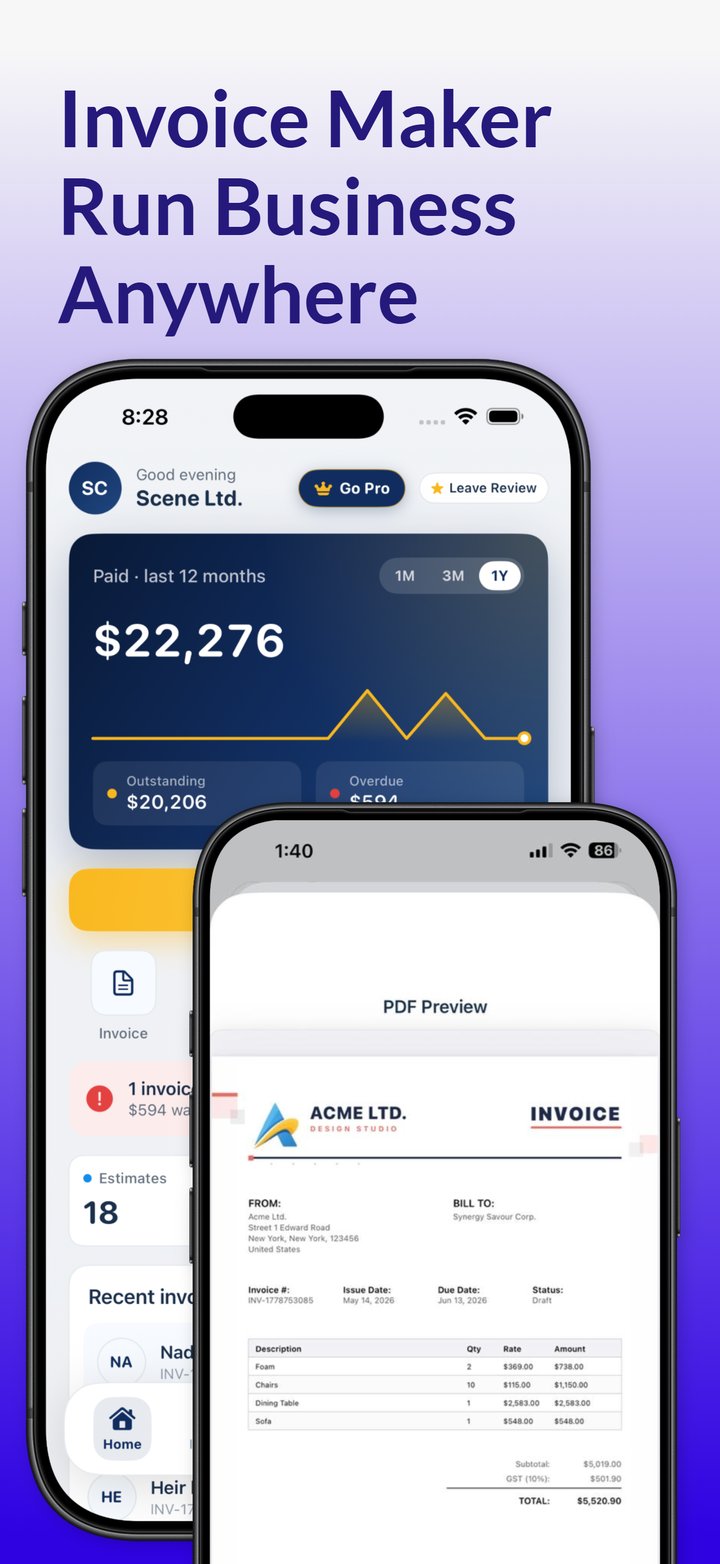
Keep your invoices and clients organized on iPhone and iPad. Invoicious lets you create invoices and estimates, duplicate a past invoice for repeat work, save client details, send PDFs by email or Messages, and see which invoices are paid, unpaid or overdue.
Get Invoicious free