A sales invoice is the document a seller issues to a buyer to request payment for goods or services sold. It lists what was supplied, the quantities and prices, any tax, the total due and the payment terms. The buyer files the same document as a purchase invoice, or bill.
Key takeaways
- A sales invoice is the seller's request for payment; the buyer records the same document as a purchase invoice or bill.
- It needs a unique number, dates, both parties' details, what was sold, the tax and the total due. VAT and GST countries require more.
- A sales order and a delivery note come before or with the invoice and record no sale; a receipt comes after and confirms payment.
- Number invoices in one unbroken sequence, never delete one you've issued, and keep copies as long as your tax authority requires.
What is a sales invoice?
A sales invoice is both the seller's formal request for payment and the record that a sale took place.
For most businesses, the name describes the direction of the sale rather than a special form: HMRC's own sample VAT invoice in VAT Notice 700/21 is headed "Sales invoice no 174". In South Asia, many businesses call it a sales bill.
The seller issues it, whether a company, sole trader or freelancer. The exception is self-billing, where the buyer prepares the invoice on the seller's behalf by agreement; in the EU, such invoices must say "Self-billing".
Sales invoice vs purchase invoice: one document, two sides
There's only one document. When Calder Kitchen Supply sends invoice INV-2026-0418 to Juniper Lane Café (the sample below), Calder files it as a sales invoice and the café files it as a purchase invoice, also called a supplier invoice or bill (here's how invoices, bills and receipts differ).
| Event | Seller's books (sales invoice) | Buyer's books (purchase invoice) |
|---|---|---|
| Invoice issued, Nov 3 | Debit accounts receivable $1,569.91; credit sales $1,481.05 and sales tax payable $88.86 | Debit equipment and supplies $1,569.91; credit accounts payable $1,569.91 |
| Invoice paid, Dec 1 | Debit cash $1,569.91; credit accounts receivable $1,569.91 | Debit accounts payable $1,569.91; credit cash $1,569.91 |
Watch the tax line. Calder books the $88.86 to sales tax payable, not sales, and clears it when it pays the state with its sales tax return. One wrinkle: Michigan's tax is levied on the retailer, and IRS Publication 334 says tax imposed on the seller belongs in gross receipts on a federal return, unlike tax imposed on the buyer. The café can't reclaim US sales tax, so it adds the tax to the cost of what it bought, per the same publication.
In VAT and GST countries, the buyer needs your invoice to recover the tax. HMRC calls the VAT invoices a business receives the primary evidence for recovering VAT. In Australia, buyers need a tax invoice to claim GST credits on purchases over A$82.50 (including GST), and registered sellers must supply one within 28 days of a request for any sale over that amount (ATO). A wrong rate or missing tax number on your invoice becomes your customer's problem, then yours.
Buyers usually match a purchase invoice to their purchase order and the delivery note before approving it, so put the customer's purchase order (PO) number on yours.
Sales invoice format: what to include
Whatever the layout, a sales invoice format needs these fields:
- Title and number: "Invoice" or "Sales invoice", and a unique number that follows on from the last.
- Dates: the invoice date, the delivery or supply date if different, and the due date.
- Your details: legal business name, address, contact details and any sales tax, VAT or GST number.
- Customer details: name and billing address, plus their tax number where required.
- References: the customer's PO number and your delivery note or sales order number.
- Line items: a description that identifies each product (a model number or SKU helps), quantity, unit price and line total. See how to write an itemized invoice a buyer can check.
- Totals: subtotal, discount, tax rate and amount, and the total due, with the currency.
- Payment terms: such as Net 30, plus how to pay and which reference to quote.
For more on each, see the step-by-step guide to professional invoicing.
What the rules add in different countries
As of October 2026:
- United Kingdom: GOV.UK lists the basics every invoice needs. If you and your customer are both VAT-registered, standard- and reduced-rate sales need a VAT invoice, normally issued within 30 days of the supply, showing your VAT number and the VAT rate and amount. Retailers needn't issue one unless asked, and sales of £250 or less can use a simplified VAT invoice.
- European Union: Article 226 of the EU VAT Directive lists the details a VAT invoice must show, including a sequential number, the supplier's VAT number (and the customer's in some cases), the supply date if it differs from the invoice date, the taxable amount for each rate, the VAT rate and the VAT due.
- United States: there's no national VAT and no federal invoice format. Sales tax is set by states and localities, so the rate depends on where the sale happens. The IRS lists invoices among the records that support gross receipts.
- India: a GST tax invoice, often called a sales bill, shows the seller's GSTIN (and the buyer's, if registered), HSN codes, the taxable value, the tax rate and amount, and a serial number of up to 16 characters, unique for the financial year (Rule 46, CGST Rules). Registered sellers of exempt supplies and composition-scheme taxpayers issue a bill of supply instead.
For VAT and GST fields in detail, see what makes a tax invoice valid.
This is general information, not tax or legal advice. Rules vary by country and change over time, so check with your tax authority or an accountant.
Sales invoice example: a sample for goods
Calder Kitchen Supply, a restaurant equipment dealer in Grand Rapids, delivers an order to Juniper Lane Café on 30-day credit. Michigan charges 6% sales tax, with no city or county sales tax on top. Here's the sales invoice sample:
Sales Invoice
No. INV-2026-0418
Invoice date: November 3, 2026
Delivered: November 3, 2026 (DN-0733)
Due date: December 3, 2026
Customer PO: JL-0927
Calder Kitchen Supply LLC
418 Foundry Street, Grand Rapids, MI 49503
(616) 555-0142
Juniper Lane Café
77 Orchard Avenue, Grand Rapids, MI 49506
| Description | Qty | Unit price | Amount |
|---|---|---|---|
| Commercial blender, 64 oz (BL-64) | 2 | $389.00 | $778.00 |
| Stainless steel prep table, 30 × 60 in (PT-3060) | 1 | $465.00 | $465.00 |
| Aluminum half-size sheet pans, case of 12 (SP-12) | 3 | $54.00 | $162.00 |
| Food storage containers, 6 qt, case of 6 (FC-06) | 4 | $38.50 | $154.00 |
Terms: Net 30. Pay by December 3, 2026 by ACH (account ending 4471) or by check payable to Calder Kitchen Supply LLC, quoting INV-2026-0418.
The four lines total $1,559.00. The 5% discount ($77.95) comes off before tax, leaving $1,481.05 taxable. Tax at 6% is $88.863, rounded to $88.86, for a total of $1,569.91.
The PO and delivery note numbers let the café match the invoice to what it ordered and received, and the written-out due date means nobody has to count 30 days. Professional invoice templates save you from starting with a blank page.
Sales invoice vs sales receipt vs sales order vs delivery note
In the sample, the café sent purchase order JL-0927; Calder confirmed it with sales order SO-1186, delivered with delivery note DN-0733, invoiced the same day and issued a receipt when paid on December 1.
| Document | Who issues it, and when | What it does | Effect on your books |
|---|---|---|---|
| Sales order | Seller, after accepting the customer's order | Confirms the items, prices and delivery date before anything ships | None: nothing has been sold yet |
| Delivery note | Seller, with the goods | Lists the items and quantities delivered, usually without prices; the customer signs for them | No sale recorded; it proves what arrived and when |
| Sales invoice | Seller, at or after delivery | Asks for payment and sets the due date | Records the sale; a credit sale creates a receivable |
| Sales receipt | Seller, when payment arrives | Confirms the amount, date and method of payment | Records the cash; on a cash sale, the sale too |
A quick test: a sales order promises, a delivery note proves, an invoice asks and a receipt confirms. In the US, "packing slip" is the more common name for a delivery note. HMRC counts orders and delivery notes among the records VAT-registered businesses must keep, so file them with the invoice.
Cash vs credit sales invoices
The format is the same; what changes is when the money arrives.
Cash sales invoice
The customer pays at the time of sale, by cash, card or instant transfer. Issue the invoice already paid, showing the amount received, the method and a $0.00 balance, and it doubles as the receipt. Record a debit to cash and credits to sales and sales tax payable. In South Asia, this document is commonly called a cash memo.
Credit sales invoice
You deliver now and the customer pays later, on terms such as Net 30. Until then, the invoice is an account receivable: money owed to you that you track and sometimes chase. Calder's invoice is a credit sale.
Your accounting method decides when the sale counts as income: in the tax year you receive the money on the cash method, or the year you earn it on the accrual method (IRS Publication 538). For a calendar-year business, goods delivered and invoiced on December 15, 2026 and paid on January 10, 2027 are 2026 income under accrual and 2027 income under the cash method.
How sales invoices feed accounts receivable and sales records
Each sales invoice lands in three places:
- The sales journal (sales day book): one line per invoice with the date, number, customer, net amount, tax and total. Its monthly totals give your sales and the tax collected.
- The customer's account in your accounts receivable ledger, showing what each customer owes. Match each payment to its invoice number.
- Your tax return: the sales tax, VAT or GST you report is the tax on your sales invoices plus any till or cash sales.
Once a month, total your unpaid invoices. The figure should equal the accounts receivable balance in your ledger; if it doesn't, a payment was misapplied or an invoice never got posted. Then sort unpaid invoices by how overdue they are and chase the oldest first.
Numbering and record-keeping basics
Give every sales invoice a unique number in an unbroken sequence. The EU VAT Directive requires "a sequential number, based on one or more series, which uniquely identifies the invoice", and HMRC uses almost the same wording for UK VAT invoices. India allows up to 16 characters, unique within each financial year. The US sets no federal format, but a clean sequence makes gaps and duplicates easy to spot.
- Pick a format and keep it. A plain sequence (1001, 1002) or a year prefix (2026-0418) both work, as do separate series per shop if no number repeats. See these invoice numbering formats.
- Never reuse or delete a number. Correct a wrong invoice with a credit note that references it, then issue a new one.
- Keep a copy of everything you issue, along with related orders, delivery notes and credit notes.
Retention periods, as of October 2026: in the US, generally three years after filing, six if you left out income worth more than 25% of the gross income on your return, and seven for a bad debt deduction (IRS). Keep purchase invoices for equipment, like the café's prep table, until that period runs out for the year you dispose of it. In the UK, keep VAT records for at least six years; self-employed people must keep records for at least five years after the 31 January deadline for that year's return. Elsewhere, check with your tax authority or an accountant.
Creating sales invoices in Invoicious
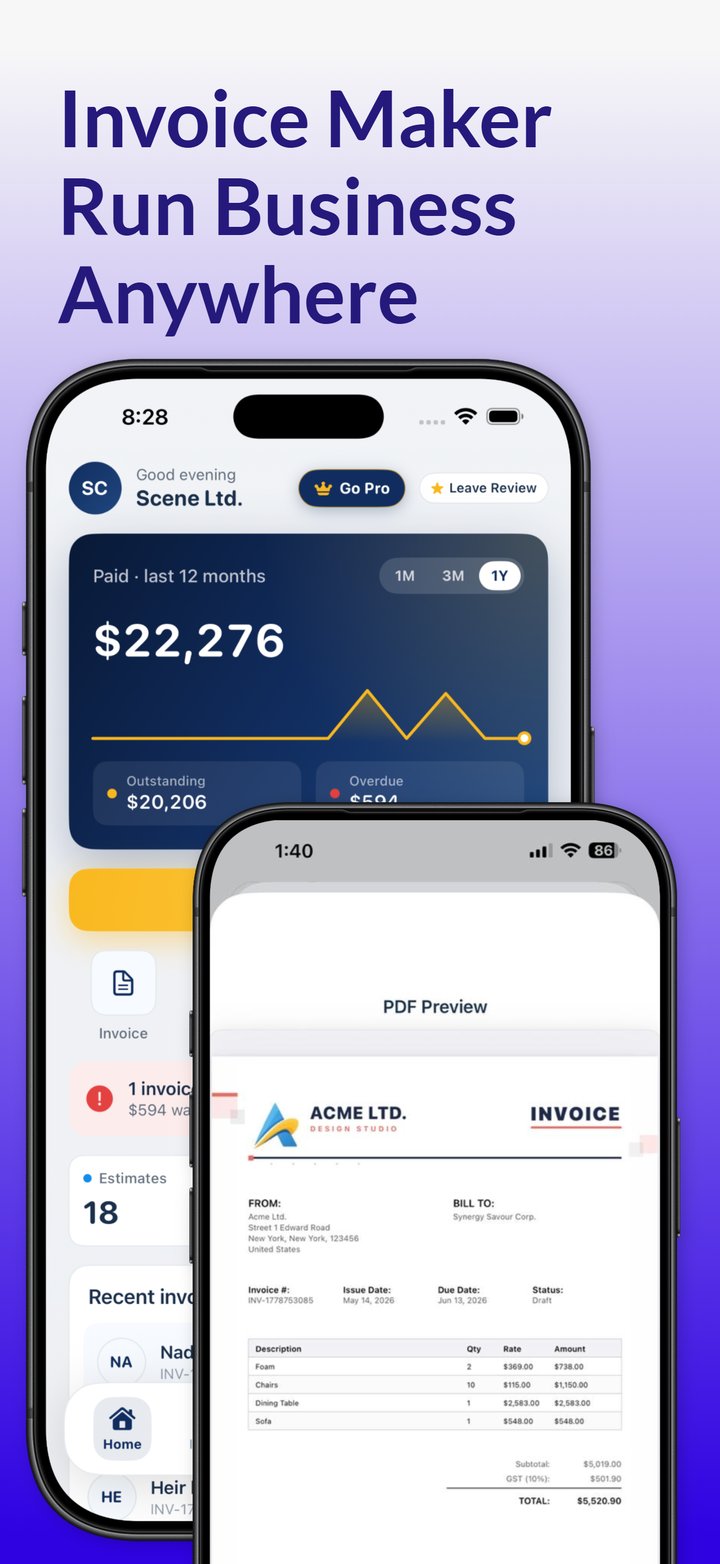
Invoicious creates sales invoices on iPhone and iPad. Choose a professional template with your logo and save client details once; the app calculates tax and discounts automatically and supports multiple currencies. Share each invoice as a PDF by email, Messages or another app, track whether it's paid, unpaid or overdue, and generate a receipt once it's paid. Duplicate a past invoice for repeat orders. It's free to download, with optional Premium in-app purchases; see the Invoicious invoice generator for more.
Send your next sales invoice from your iPhone. Invoicious is free to download.
Get Invoicious free