An invoice is a seller's request for payment. A bill is usually the same request seen from the buyer's side, or the total a restaurant or shop hands you before you pay. A receipt confirms that payment has been made. So the invoice and bill come before the money moves, and the receipt comes after.
Mixing them up has real costs: a supplier's statement gets paid as if it were a new invoice, or you can't prove a payment at tax time. Below, six documents are defined, compared and followed through one order.
Key takeaways
- An invoice asks for payment and a receipt confirms it. An invoice alone doesn't prove payment.
- An invoice and bill are usually one document: the seller records an invoice in accounts receivable, and the buyer records a bill in accounts payable.
- A typical order runs purchase order → invoice → payment → receipt → statement.
- Keep each invoice or bill with its proof of payment for as long as your tax authority requires.
Invoice, bill and receipt: what each one means
Invoice
A seller usually issues an invoice once goods are delivered or work is done, or at an agreed stage of a longer job. It lists what was supplied, the prices, any tax, the total and the due date, and it records that money is owed. Here's what every invoice should include.
Bill
Cambridge Dictionary defines a bill as "a request for payment of money owed", which describes an invoice just as well. In practice, "bill" usually means one of three things:
- A supplier's invoice, seen from the payer's side.
- The total presented at a restaurant table or shop counter before you pay.
- A utility, phone or medical bill: an invoice sent to a household.
In every case, a bill comes before payment. Paying it doesn't turn it into a receipt.
Receipt
A receipt is issued by whoever was paid, usually the seller, to confirm a payment: who paid, how much, when, by what method and for which invoice. It asks for nothing. GOV.UK draws the same line: an invoice is not the same as a receipt, which is "an acknowledgement of payment". At a shop till, the sale and the payment happen at once, so the printed receipt both records the sale and proves payment.
Quote, purchase order and statement of account
Three more documents surround the invoice, and each gets mistaken for one.
- Quote (or estimate): the seller's price offer before work is agreed. A quote is typically a fixed price for a set period; an estimate is an approximation that can change. Neither asks for payment. Here's how quotes, estimates and invoices differ, and why a proforma invoice belongs in the same pre-sale group.
- Purchase order (PO): the buyer's order to the seller, with items, quantities, agreed prices and a PO number. It shows the purchase was approved on the buyer's side.
- Statement of account: a periodic summary, usually monthly, that a seller sends a customer with an ongoing account. It lists invoices, payments and credits and ends with the balance owed. It adds no new charges.
Invoice vs bill vs receipt: comparison table
| Document | Who issues it | When | What it proves | Requests payment? |
|---|---|---|---|---|
| Quote or estimate | Seller | Before the work is agreed | The price offered, and for how long | No |
| Purchase order | Buyer | When the order is placed | What was ordered, at what price, and that the purchase was approved | No |
| Invoice | Seller | On delivery, on completion or at an agreed stage | What was supplied, how much is owed and by when | Yes |
| Bill | Seller (it's the invoice, named from the buyer's side); also restaurants, shops and utilities | Before payment | The amount owed | Yes |
| Receipt | Whoever was paid | After payment | That a stated amount was received, when and how | No |
| Statement of account | Seller | Periodically, often monthly | The balance across all invoices, payments and credits | No new charges; it shows what's still due |
In short: the quote and PO come before the sale, the invoice (or bill) asks for the money, the receipt confirms it arrived and the statement keeps score.
Invoice and bill: one document, two points of view
When you email a client an invoice, it lands in their books as a bill. The PDF doesn't change; the point of view does.
For you, the seller, it's a sale and an account receivable: money a customer owes you. For the buyer, it's an expense (or an asset, if it's equipment) and an account payable: money they owe. Our guide to sales invoices and purchase invoices shows the bookkeeping entries on each side.
Why accounting software keeps invoices and bills apart
Because each side records the document differently, small-business accounting software usually keeps invoices and bills in separate areas:
- Invoices you send build up accounts receivable, an asset. These are the payments you chase.
- Bills you enter build up accounts payable, a liability. These are the payments you schedule.
So when a supplier's invoice arrives, enter it as a bill, even though it says "Invoice" at the top. Entered as an invoice, it would show money owed to you instead of by you.
Customer invoice vs vendor invoice (supplier invoice)
These labels describe direction, not a different kind of document:
- A customer invoice is one you send to a customer. It sits in accounts receivable.
- A vendor invoice, or supplier invoice, is one you receive from a business you buy from. Once entered for payment it's usually called a vendor bill, and it sits in accounts payable.
Before approving a vendor bill, compare it with the purchase order (right items and prices?) and with what actually arrived (did you receive everything billed?). Accounts payable teams call this a three-way match. Then make sure it isn't a copy of one you've already paid. When you're the seller, quote the PO number and match the order line for line, because invoices that don't match tend to stall in approval queues.
What "bill" means in different places
In US and UK business-to-business trade, sellers usually title their document "Invoice", and "bill" tends to appear as a verb ("we'll bill you monthly") or on the buyer's side. Elsewhere, the word often does more work.
South Asia: "bill" often means the invoice
In India, Pakistan and much of South Asia, "bill" is commonly used for the invoice itself. Someone searching for a "bill format" or an "invoice bill" template usually wants an invoice layout, and a shopkeeper's handwritten bill typically does the job of a sales invoice.
Tax law can use the word more narrowly. Under India's GST, a registered business normally issues a tax invoice, but one that makes only exempt supplies, or uses the composition scheme, issues a bill of supply instead, as CBIC's GST flyer on tax invoices explains.
Restaurants and shops: the bill comes before payment
In British English you ask for the bill at the end of a meal; Cambridge gives "check" as the American word. Either way, it's normally presented before you pay, like the bill a shopkeeper writes up at the counter. The card slip or receipt you get afterward is the proof of payment.
One order, every document: a worked example
Lantern Print Studio, a small print shop, prints marketing materials for Greenway Dental Clinic on 30-day terms. Both businesses are fictional.
- Purchase order, October 5, 2026. Greenway accepts Lantern's quote and sends PO-2291 for 1,000 tri-fold brochures at $0.42 ($420.00), 2,000 appointment cards at $0.06 ($120.00) and two pull-up banners at $145.00 ($290.00): $830.00 before tax. Nobody owes anything yet.
- Invoice, October 14. Lantern delivers and issues invoice INV-1047, quoting PO-2291: $830.00 plus sales tax at an illustrative 7% ($58.10), a total of $888.10, due November 13 on Net 30 terms. Lantern records an $888.10 receivable.
- Bill, October 15. Greenway checks INV-1047 against the PO and the delivery, then enters it as an $888.10 vendor bill in accounts payable. Same document, now a bill.
- Payment, November 10. Greenway pays $888.10 by bank transfer, with INV-1047 as the reference. Lantern's receivable and Greenway's payable both fall to zero.
- Receipt, November 10. Lantern matches the transfer, marks the invoice paid and sends receipt RCT-0318 (below).
- Statement, November 30. Lantern's first statement covers the account since it opened in October. It shows the paid invoice and a new one: INV-1063, dated November 24, for 3,000 reprinted appointment cards ($180.00 plus $12.60 tax, so $192.60), due December 24.
Receipt
No. RCT-0318
Date received: November 10, 2026
Method: Bank transfer
Reference: INV-1047
Lantern Print Studio
214 Mill Street, Riverton
Greenway Dental Clinic
9 Elm Court, Riverton
| Payment for | Invoice date | Invoice total | Amount paid |
|---|---|---|---|
| Invoice INV-1047 (your PO-2291) | October 14, 2026 | $888.10 | $888.10 |
Balance remaining on INV-1047: $0.00. Thank you for your payment.
And here's the statement Greenway receives on November 30:
| Date | Details | Charges | Payments | Balance |
|---|---|---|---|---|
| Oct 14 | Invoice INV-1047 (PO-2291) | $888.10 | $888.10 | |
| Nov 10 | Payment received, receipt RCT-0318 | $888.10 | $0.00 | |
| Nov 24 | Invoice INV-1063 (card reprint) | $192.60 | $192.60 | |
| Nov 30 | Balance owed (INV-1063, due Dec 24) | $192.60 |
Only the invoices and the payment changed anyone's books; the PO came before any debt, and the receipt and statement are evidence and summary. The statement also shows why you pay invoices, not statements: its charges add up to $1,080.70, but only $192.60 is owed. For your own, start from these customizable invoice templates.
Which document proves payment?
An invoice or bill proves a debt, not a payment. Proof of payment is one of these:
- A receipt showing the amount, date, method and the invoice it settles.
- A paid invoice: the original, updated with the payment date, method, reference and a zero balance. Many business clients accept this in place of a separate receipt; here's how to mark an invoice as paid.
- A bank or card record. In the US, IRS Publication 583 says that, without a canceled check, a legible bank or card statement can prove payment if it shows the amount, the payee's name and the posting or transaction date (plus the check number for checks).
The IRS adds that proof of payment, by itself, doesn't establish that you're entitled to a tax deduction. So keep the invoice or bill (what you bought) with the proof that you paid.
Record-keeping basics for invoices, bills and receipts
Keep documents in both directions, filed by transaction:
- Sales: customer POs, the invoices you issue, any credit notes, and copies of the receipts and statements you send.
- Purchases: your own POs, vendor bills, delivery notes, suppliers' statements, and the receipts or bank records that show you paid.
Publication 583 lists paid bills, invoices, receipts and canceled checks among the supporting documents to keep, and HMRC's guidance on records the self-employed must keep lists receipts, bank statements and sales invoices as types of proof.
How long? The IRS says to keep records for three years after filing in most cases, six if you leave out income worth more than 25% of the gross income on your return, and seven if you claim a bad debt deduction. Self-employed people in the UK must keep records for at least five years after the January 31 submission deadline for the tax year.
Record-keeping rules vary by country and change over time. This is general information, not tax or legal advice, so check your tax authority's guidance or ask an accountant.
Invoices, bills and receipts in Invoicious
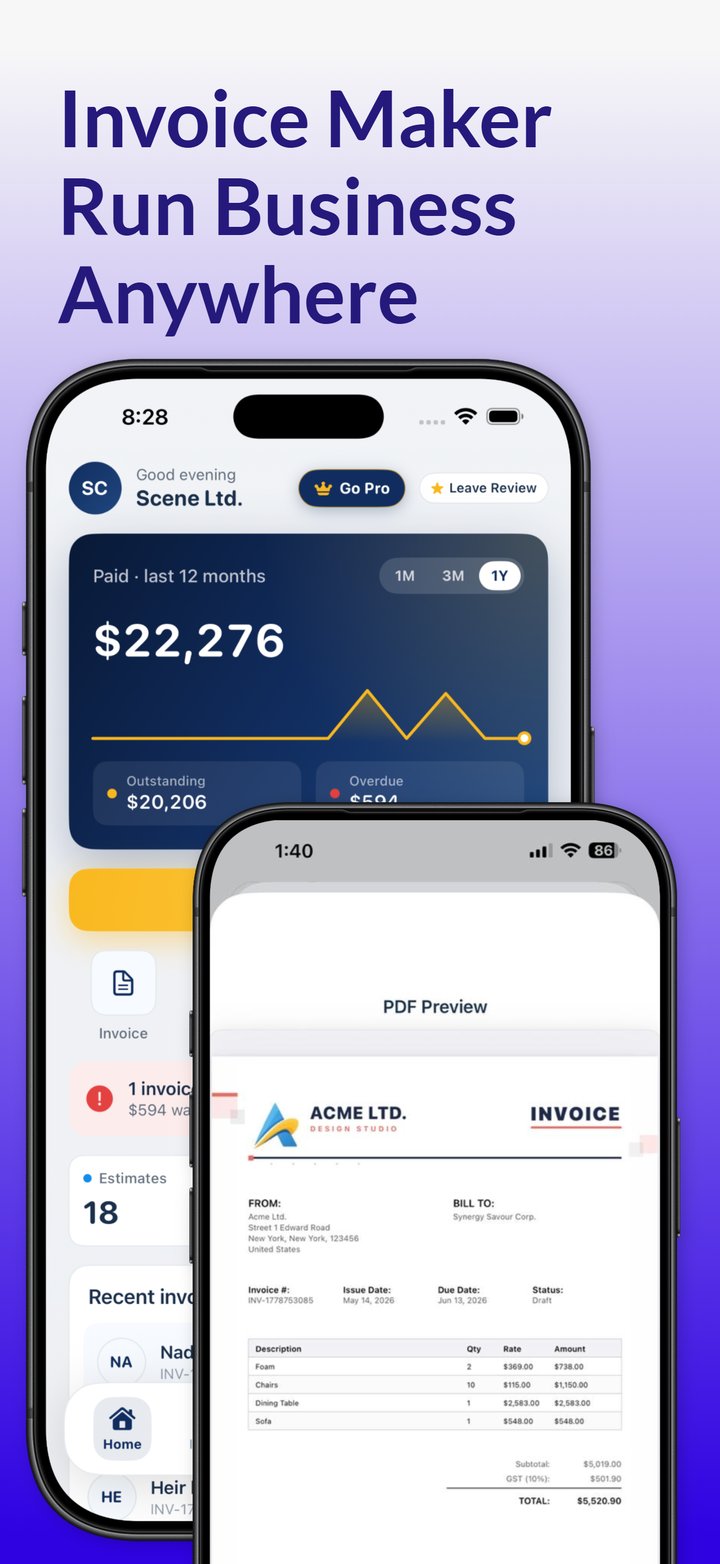
Invoicious is an invoicing app for iPhone and iPad. It creates invoices, estimates, quotes, receipts and bills. It converts an estimate into an invoice and generates a receipt once an invoice is paid. Documents go out as PDFs by email or Messages, tax and discounts are calculated automatically, and it tracks whether each invoice is paid, unpaid or overdue. It's free to download, with optional Premium in-app purchases; the invoice generator app page has more detail.
Send the invoice, then the receipt, from your iPhone. Invoicious generates a receipt once an invoice is paid, ready to send to your client as a PDF.
Get Invoicious free